You’ve narrowed your shortlist to a handful of hosts, and every one of them has a review badge. One shows 93%, another 95%, a third 100%. The numbers look decisive.
They aren’t, at least not on their own.
When you’re choosing web hosting for an online store, review scores tell you how other customers felt about a feature. They don’t tell you how fast your checkout will load on a sale day or how quickly you’ll recover a corrupted orders table.
Here’s how to read ScalaHosting’s G2 ratings, what they actually measure, and what you still need to check yourself.
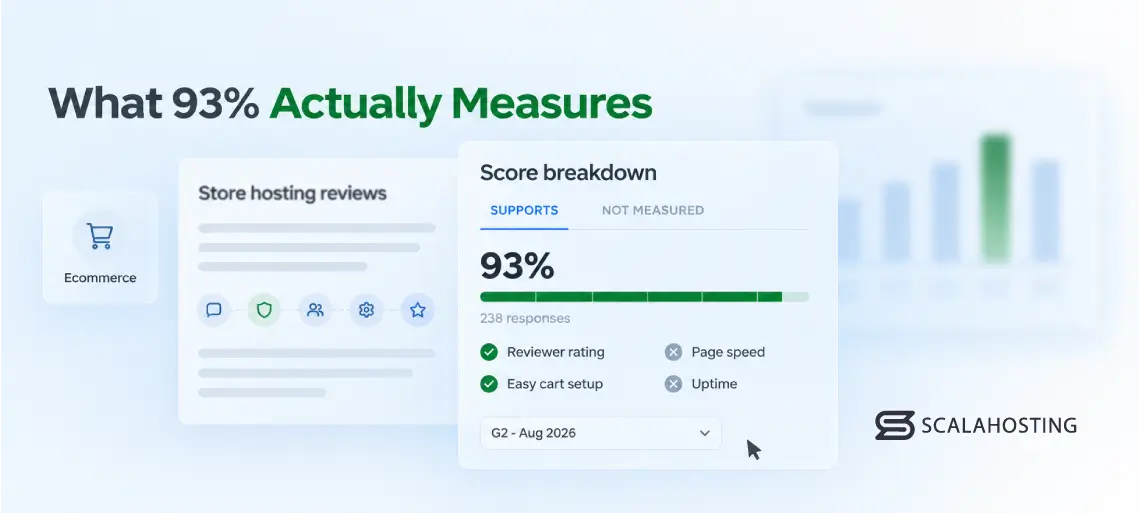
ScalaHosting received a 93% Ecommerce Integration score from 238 responses in G2’s comparison, the highest displayed score among the six providers reviewed. The score reflects how reviewers rated the feature, not a controlled speed, uptime, or conversion test. Treat it as evidence that reviewers report a good experience integrating ecommerce tools, then verify your own platform, integrations, and recovery needs.
Key Facts at a Glance
Here’s the evidence this article relies on:
Source: G2 User Satisfaction Ratings comparison of six hosting providers
Data date: reviews collected as of August 2, 2026
Metric: Ecommerce Integration
ScalaHosting score: 93% from 238 responses
Related metric: Database Support, 95% from 258 responses
Providers compared: ScalaHosting, Cloudways, Hosting.com, Hostinger, InMotion Hosting, and Liquid Web
What it measures: reviewer ratings of the feature on G2’s review form
What it doesn’t measure: page speed, uptime, conversion rate, or load capacity
You can read ScalaHosting’s public reviews on G2’s ScalaHosting profile without logging in to any gated report.
What the 93% E-Commerce Integration Score Actually Measures
A G2 feature score summarizes how verified reviewers rated one specific capability. Reviewers rate features on G2’s review form, and a product’s Features tab appears only after it collects at least 10 responses to feature questions, according to G2’s documentation.
G2 describes Ecommerce Integration as the ability to install tools such as shopping carts. So the 93% answers a narrow question: did reviewers find it easy to get ecommerce software running on the platform?
That’s a useful question for a store owner. But it just isn’t the only one.
Here’s what the score does and doesn’t support:
The Score Supports
The Score Doesn’t Support
Reviewers rated ecommerce integration highly
Your store will load faster
238 responses, so one new rating barely moves it
Your conversion rate will improve
ScalaHosting ranked highest of six on this metric in this report
ScalaHosting is the best host for every store
A signal worth weighting in your shortlist
Proof of performance under your traffic
The same logic applies to Database Support. A 95% score from 258 responses says reviewers were satisfied with how the platform handles databases. G2 uses one generic feature description across all hosts, so read the score as satisfaction, not as a list of the database engines a specific host runs.
How ScalaHosting Compares on G2: Scores and Response Counts
G2’s User Satisfaction Ratings comparison covers six providers, with reviews collected as of August 2, 2026. The table below lists each provider’s Ecommerce Integration and Database Support scores, along with the number of responses.
Provider
Ecommerce Integration
Responses
Database Support
Responses
ScalaHosting
93%
238
95%
258
Hosting.com
89%
57
89%
89
Cloudways
87%
300
87%
337
InMotion Hosting
86%
25
83%
34
Hostinger
85%
281
86%
325
Liquid Web
42%
8
64%
13
Source: G2 User Satisfaction Ratings, reviews collected as of August 2, 2026. Scores reflect reviewer feedback, not performance testing.
ScalaHosting shows the highest displayed score on both metrics. Two other details matter just as much. Cloudways and Hostinger have more Ecommerce Integration responses than ScalaHosting (300 and 281 versus 238), so their scores are equally well supported. Response counts across the six providers range from 8 to 300, which changes how much weight each percentage deserves.
What Reviewer Feedback Can’t Tell a Store Owner
Reviews describe past experiences across many different stores. Your store has its own traffic, catalog size, plugins, and payment setup. No review score answers these questions for you:
How fast does your product page render with your theme and plugins?
How does checkout behave when 200 people hit it in the same minute?
Does your payment gateway, ERP, or shipping tool connect without custom work?
How much order data would you lose if the database broke right now?
How long would a full restore take?
You answer the first two by testing on a staging copy. You answer the last three by checking what the host actually provides for integrations and recovery.
The next section covers what that looks like on ScalaHosting.
SPanel Capabilities That Matter for Online Stores
An integration score is a reviewer’s summary. Day-to-day, integration means caching that works with your store platform, PHP settings you can change yourself, alerts when something breaks, and a way back when data goes wrong.
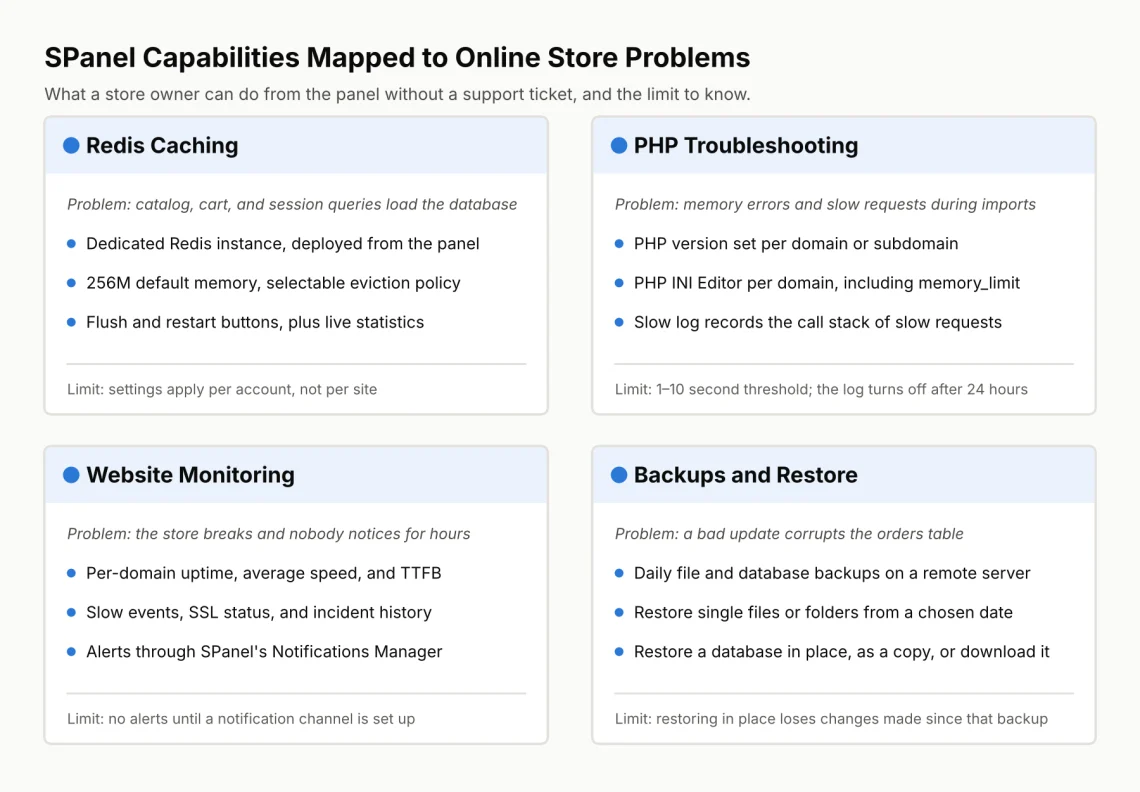
SPanel, our in-house control panel, handles each of these without a support ticket, available with every ScalaHosting managed VPS at no extra cost.
Here’s how each capability maps to a store owner’s problem.
Redis Caching for Catalog Queries, Carts, and Sessions
Ecommerce platforms hit the database constantly: product listings, cart totals, customer sessions. A cache keeps frequently used data in memory so repeat requests skip the database.
SPanel’s Redis Cache screen deploys a dedicated Redis instance for your account in one click. It’s not shared with other customers. Each instance gets its own private loopback address, password, and a default 256 MB memory limit you can raise in the Settings form. You plug the host and password into your platform’s Redis plugin or config, and the store starts using it. Magento, WordPress with WooCommerce, and Laravel all support Redis this way.
You also get the controls you’d normally ask support for: flush the cache after a deploy, restart the instance, pick one of eight eviction policies from a dropdown, and watch live Redis commands to confirm your plugin is actually using the cache.
Note: With SPanel, you get one Redis instance for your web hosting account, not for every website within the account (if you have more than one).
PHP Troubleshooting Without Waiting on a Ticket
Most ecommerce platforms run on PHP, and error traces often point to a PHP setting: a memory limit too low for an import, an upload size too small for a product image batch, or an execution timeout during a catalog sync.
SPanel’s PHP Manager lets you:
Set the PHP version per document root, so a store and a legacy tool can run different versions on one account
Change eight common php.ini settings through a validated form, including memory_limit, max_execution_time, and upload_max_filesize
Edit the full php.ini when you need a directive the form doesn’t cover
Turn on the PHP-FPM slow log with a threshold, so any request slower than, say, three seconds gets logged with a stack trace
On a day when the store just feels slow, the slow log ends the guesswork. It points to the exact script and line that’s dragging. Remember to switch it off when you’re done, because it doesn’t expire on its own and keeps writing to disk.
The first is a service watchdog. Every five minutes, SPanel checks the web server, MariaDB, the mail server, FTP, IMAP, DNS, and every installed PHP-FPM version, and restarts anything that has stopped. It checks whether a process is running, not whether it’s responding, so a hung service can still need human attention.
The second is website monitoring you configure per domain. You choose a check interval of 1, 5, 10, or 15 minutes, a speed threshold, and SSL expiration alerts. For a store, the most valuable option is the text-presence check. Point it at a phrase that should always appear on your checkout or product page, and SPanel flags the site as down if the text disappears, even when the server still returns HTTP 200. That catches the silent failures standard uptime checks miss.
One caveat: a monitor running on the same server goes down with that server. If you run more than one ScalaHosting server, configure them to monitor each other, which gives you external monitoring without a separate uptime service.
Hosting for an Online Store: A Pre-Purchase Evaluation Checklist
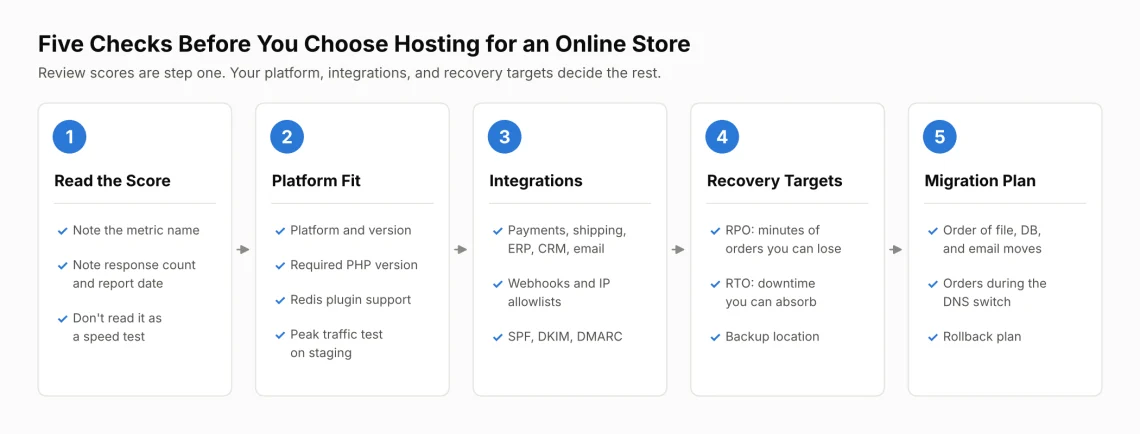
Use this checklist before you commit to any host, ScalaHosting included. Bring your answers to the sales or migration conversation.
Your Store Platform
Which platform and version do you run (WooCommerce, Magento, PrestaShop, a custom PHP app)?
Which PHP version does your platform and every plugin require?
Does your platform support Redis for object cache or sessions, and is there a maintained plugin?
What are your peak traffic moments (launches, sales, seasonal spikes), and can you test them on staging?
Your Integrations
List every external system the store talks to: payment gateway, shipping, ERP, CRM, email marketing, tax service.
Note which ones need outbound API access, inbound webhooks, or fixed IP allowlisting.
Check which integrations send transactional email from the server, and confirm SPF, DKIM, and DMARC can be set up for your domain.
Flag any integration that depends on a cron job or a long-running PHP process.
Your Recovery Requirements
Recovery point objective (RPO): How many minutes of orders can you afford to lose? If the answer is “under an hour,” you need database snapshots more frequent than hourly backups.
Recovery time objective (RTO): How long can the store be down before it costs real money?
Where must backups live: same server, separate server, or object storage you control?
Can you restore one database or one folder without rolling back the whole account?
Your Migration Plan
Who moves the files, database, and email, and in what order?
How will you handle orders placed during the DNS switch?
Is there a rollback plan if the new environment misbehaves?
For WordPress-based stores, our walkthrough on migrating a WordPress site covers the sequence in detail. For a broader look at what an ecommerce workload needs from a server, see our guide to hosting for online stores.
Get a Hosting Assessment for Your Store
ScalaHosting’s 93% ecommerce integration score on G2 is a strong signal, not a verdict.
The decision gets clear once you match your platform, integrations, and recovery targets against what a host actually runs, and our G2 support quality comparison covers the support side.
Q:What does G2’s Ecommerce Integration metric measure?
A: It measures how reviewers rated a host’s ability to install ecommerce tools such as shopping carts. G2 collects these ratings on its review form. The metric reflects reviewer satisfaction, not technical testing.
Q:Does a 93% Ecommerce Integration score mean ScalaHosting is the fastest host for online stores?
A: No. The score reflects how G2 reviewers rated ScalaHosting’s ecommerce integration. It’s reviewer feedback, not a speed or conversion benchmark. To judge speed, test your own store on a staging copy.
Q:How many reviews are behind ScalaHosting’s G2 Ecommerce Integration score?
A: 238 responses to date. ScalaHosting’s Database Support score, 95%, comes from 258 responses. At that sample size, one new review can move either score by less than half a percentage point.
Q:Is a feature score based on a small number of responses reliable?
A: It’s less stable. With 8 responses, one new rating can shift a score by up to 11 points. In G2’s comparison, Ecommerce Integration response counts range from 8 to 300 across the six providers. Read every score alongside its response count before comparing providers.