OpenCart Guide: Choosing the Right Provider and Web Hosting Plan

There are currently nearly 1,000 different ecommerce solutions, and OpenCart holds about 0.7% of that market. It might not sound like a lot, but we have to consider that only a few platforms hold the lion’s share when it comes to online shops – WooCommerce, Shopify, and Wix are the clear dominators here.
This means that OpenCart is still one of the frontrunners from the rest of the pack, along with Magento and PrestaShop. The CMS is responsible for hundreds of thousands of websites (numbers vary between platforms) and is one of the most preferred tools for creating stylish online shops for people with minimal technical experience.
Today, we will be lifting the curtain for anyone considering starting a project with OpenCart – what can you expect from the ecommerce app, and how can you find the best hosting provider to help you lift your store off the ground?
First things first.
Understanding OpenCart Hosting Requirements
Just as with any other application, OpenCart cannot function in any hosting setup. Your web server should cover certain system requirements. Luckily, the basic preconditions to run this ecommerce app are fairly simple:
- PHP 8.0 or later
- MySQL version after 5.7 (as it entered end-of-life at the end of 2023). PostgreSQL is also supported.
The following PHP libraries are also needed:
- Curl
- GD Library
- Iconv
- Mbstring
- OpenSSL Encrypt
- ZipArchive
- Zlib
Finally, some PHP settings you should look to be turned on:
- file_uploads
- magic_quotes_gpc
- register_globals
- session_auto_start
Though it might seem like a lot, those are actually very basic settings, and 99% of hosting providers support this configuration even on a shared server plan.
There is one important disclaimer, though.
While OpenCart can be installed on a shared hosting package, once your website starts gaining traction, you will quickly see its performance drop. Each visitor takes resources from the server, and the shared environment will limit you in many ways once that happens. You should keep in mind that there are hundreds of other clients on that server, and each one utilizes the same pool of CPU and RAM.
The same goes for any ecommerce project, not just the ones built with OpenCart.
A virtual private server is the way to go if you plan to have a successful online shop, and here is why.
Performance Optimization
One of the main goals for your ecommerce website is to make it fast. It is a well-known fact that visitors care a lot about page loading speeds, so much so that 3 out of 4 people will leave a page if it fails to open in about 3 seconds. That holds true not just for your product pages but your checkout process as well.
One thing you should know about speed optimization in OpenCart is that it is a shared responsibility between you and your hosting provider. Even if you follow all the good development practices and apply the known guidelines (image optimization, code minification, content caching), you will just waste your efforts if your web server is lagging behind.
A reliable hosting provider will not only optimize their machines for speed – they will go above and beyond to include additional tools and settings that will help you achieve the fastest possible performance. Think of things like CDN solutions, caching mechanisms, and lightweight servers.
How Can ScalaHosting Help with Performance
At ScalaHosting, we hold site speed as the utmost priority, especially for ecommerce clients. Our services fully support the fastest possible server solutions (LiteSpeed and OpenLiteSpeed), and we encourage you to pair them with the right plugins. LiteSpeed Cache has been tested thoroughly in that aspect, and we can guarantee this add-on works wonders when activated in such an environment.
Additionally, CDN integration is absolutely possible with Scala. While we offer a quick solution to activate Cloudflare, you can choose any other platform and use it in our control panel.
Security Measures and Support
Cybersecurity in ecommerce is a concern you shouldn’t take lightly. When dealing with sensitive customer data, hundreds of things can go wrong. Unless you protect your website against all kinds of vulnerabilities, you will have a hard time gaining the trust and loyalty of your visitors.
So, what can you do?
For starters, you should install an SSL certificate. Without it, your visitor’s browsers will spew out a plethora of warnings and errors, which will immediately turn away most potential shoppers. The SSL certificate will not only encrypt the connection between the user browser and the hosting server but will also help with search engine optimization.
Look for providers with secure data centers and numerous methods for data protection – things like network firewalls, security modules, and DDoS protection should be expected.
Never underestimate the power of backups. Even if everything is running smoothly, the unexpected can happen, and you have to be prepared with a plan B.
How Can ScalaHosting Help with Security
OpenCart users can have peace of mind knowing that ScalaHosting watches over their server at all times. Thanks to our unique monitoring tool, SShield, all clients can benefit from constant malware scanning and intrusion detection. Trained to spot even the slightest vulnerability, our security solution will immediately notify the webmaster if there is any potential danger.
Anti-spam filters, robust network firewalls, and DDoS protection – all these things are a given with Scala.
In terms of SSL certificates, we partner up with industry leaders Let’s Encrypt to give you free security certification. Not only that, but it is also automatically applied to each new account. If you choose to use a third-party solution, our technical support team can help with its configuration.
We haven’t forgotten about backups.
In fact, we offer a custom backup and restore tool that will help you archive your data on a secure offsite server and restore it whenever needed. Even if someone manages to take down your website – you can easily bring back a working copy and never lose any sales or web visits.
Scalability and Growth Potential
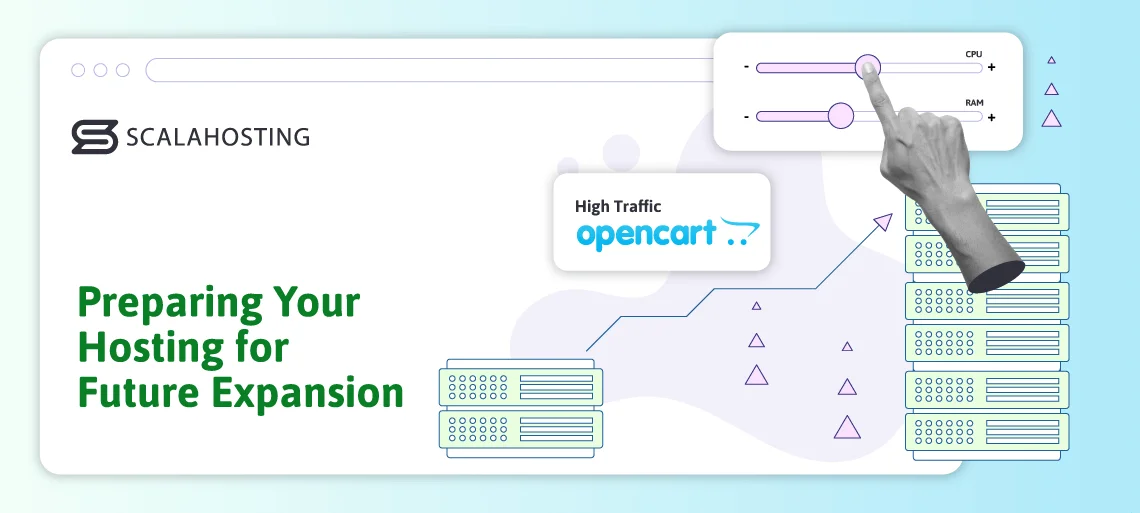
One of the best selling points of VPS servers is their scalability. Even if you have a solid plan and a detailed site characteristic, no one can predict the future and just how popular your ecommerce project might become.
Traffic spikes are to be expected when managing an online shop. Be it an exciting new product, a successful ad, or a global marketing campaign, your visitor count can surge at any time. And even if you have plenty of resource overhead – the demand can easily outgrow the supply.
A VPS allows you to scale CPU and RAM up and down on a per-need basis. Whenever you see you are close to hitting any limits, you just add more to maintain uninterrupted uptime and optimized performance. This is impossible on a shared server. Any traffic surge will quickly render your website unresponsive, and you will start losing sales. And even if you upgrade your hosting plan to accommodate more – what’s to say the same wouldn’t happen in another week if your website keeps growing?
How Can ScalaHosting Help with Scalability
Understanding the needs of ecommerce shop owners, our VPS plans are fully scalable. The client has quick access to more resources with the push of a button. It all happens seamlessly and without the need for service upgrades.
Moreover, the ScalaHosting virtual servers are all truly cloud-based. Tapping into a limitless pool of system resources means your store can grow indefinitely. Even if you need a monster machine with 128 CPU cores and 256 GB RAM, this is absolutely possible with us.
Apart from the fixed plans to start you off, Scala offers a custom VPS builder. You can choose your own CPU power, RAM, SSD storage, and billing plan. Naturally, this package is also subject to scalability and can be changed at any time without losing any of your prepaid periods.
Uptime and Reliability
Imagine landing on a web page, and it takes forever to load (if it even fully loads at all).
Seems fishy, to say the least.
Now, imagine if this was an ecommerce website and you were expected to leave your personal and billing details there. You will most probably close it, never to return again.
Uptime is a huge factor in the success of ecommerce stores. Especially if you already have a stable influx of visitors, even a few seconds of downtime will surely be noticed and have a negative impact on your traffic and expected sales.
In the world of web hosting, 99% uptime simply won’t cut it. And even though 100% is understandably an impossible dream, any reliable provider will take the necessary measures to bring that number as close to perfection as possible.
How Can ScalaHosting Help with Uptime
By taking advantage of cloud technology, your uptime is well-guaranteed. This type of hosting means your website is replicated in a vast network of servers, eliminating the single point of failure that comes with a standard physical server.
Bigger and high-traffic online shops have it even easier. By utilizing one of our multi-datacenter cluster plans, you can avoid downtimes even if a big fire or a tornado hits your data center facility—a different one will immediately activate and keep your website intact.
Still, we believe you should be compensated for every little issue, so our services come with a comprehensive Service Level Agreement (SLA). Any real downtime that brings your score below 99.9% entitles you to reimbursement, and you can find the exact numbers in our Terms of Service.
User-Friendly Control Panels
Unless you are a seasoned developer who is a wizard with the terminal, chances are you will need a control panel to manage your site functionalities. And not just any control panel but one that is straightforward and easy to use even by a complete newbie.
Running a hosting account requires managing more than a few small tasks and features. For starters, you need quick access to your site files and databases. If you use the same provider for your domain names, the control panel should include that, too. And that’s just scratching the surface – email accounts, PHP versions, software auto-installers, backup solutions, cron jobs – you have a wide array of functionalities that you need to operate frequently.
If you manage your own VPS server for your OpenCart project, you have even more responsibilities to consider – creating user accounts, allocating resources, and restarting services, to name a few.
Overall, the control panel is an integral part of your day-to-day operations and should be one of your prime concerns when picking a hosting provider.
How Can ScalaHosting Help with Control Panels
If this is not your first time building a website, you are probably familiar with the popular solutions on the market – cPanel, Plesk, and DirectAdmin have been around for many years now.
ScalaHosting can do one better for you, though.
SPanel is a self-developed hosting management solution that includes all your favorite features from other control panels…and more. You get an intuitive Admin Interface to manage your server and a User Interface for each individual account. The options are straightforward and easy to navigate.
The best thing is that SPanel never stops improving. Even though our panel is full of features, we never stop adding more. And those functionalities are directly influenced by you, the user. In your Feature Requests forum, visitors can make suggestions and vote on what others propose. The most popular ideas are immediately put on our to-do list and are soon introduced with one of the next software updates.
To top it all off, SPanel is very lightweight, so your server will not suffer from performance drops or service interruptions.
Customer Support and Technical Assistance
Buried in all the technicalities surrounding ecommerce site building, we often forget the utmost importance of proper customer support. Let’s face it – even the most experienced web developers will sooner or later bump into an issue that will require some extra helping hand. And if you know more than the operators of your chosen provider – you are pretty much left on your own.
Before choosing your next OpenCart hosting provider, it’s best to thoroughly test its support services. While it’s great to have multiple ways of communicating with your host—live chat, email, phone, ticketing—you really need to ensure that the operators are knowledgeable enough to assist you with any issue.
Start by testing the support team’s response time. How long does it take them to enter the chat or respond to your ticket? Are they responding to your questions quickly or leaving you hanging while they search for a response?
Naturally, efficiency is the main factor to consider. Can the reps understand your questions easily and come up with a suitable solution on the spot? Is it possible to escalate the issue if your operator cannot come up with an appropriate answer?
Do not underestimate the way the operators communicate with you. Do you get clear and friendly explanations, or are the answers short, templated, and just lead to more confusion?
A good idea here is to test the customer support team and technical operators multiple times and at different times of the day. Accidents may occur at any time, and you want to be sure that there is always someone available to swiftly assist you.
How Can ScalaHosting Help with Customer Support
At ScalaHosting, we take great pride in the knowledge and professionalism of our support. Contrary to many other hosts, we are prepared to provide technical assistance directly in the live chat, and if the issue is too complex, it can easily be escalated to a Level 2 or Level 3 operator.
Our live chat is available 24/7, with an initial response within seconds. The same goes for the ticketing system, where you can expect a first reply within 15 minutes (many times, a second one is never needed).
The Scala Support Team is well-versed in OpenCart and other ecommerce solutions, allowing them to understand and offer assistance for various issues without wasting your time with unhelpful templated responses.
Choosing a managed VPS plan will allow you to take advantage of our entire workforce every step of the way. Our technicians will configure your OpenCart server and equip it with the needed software to start your online store journey. What’s more, we will always be available to lend a helping hand with any hosting-related concern and give valuable insights on how to get the most out of your service with us.
Cost-Effective Hosting Solutions
It’s great to find an excellent hosting provider that seems to tick all the boxes—performance optimizations, rock-solid security, an intuitive interface, and wonderful support. But then comes the big question—can you really afford it?
Startups and small businesses often have to compromise on some of their requirements because they’re working on a budget, and the top solutions are simply too expensive. This creates a paradox – you need to grow your online shop to gain more revenue and afford better hosting, but without the right environment, you don’t have the foundation to accommodate more customers.
That’s not even the only concern.
There are literally thousands of vendors out there, and researching them all to find the best combination of features vs. cost is next to impossible. That’s why it’s imperative to look at the whole package, see what’s included, and how many of your needed features are included for free. Many times, a host might seem affordable but only gives you a bare-bone server with each extra feature paid additionally.
How Can ScalaHosting Help with Cost-effectiveness
Knowing the essential needs of OpenCart store owners, we aim to make our packages a one-stop shop where the price reflects the entire scope of your needs.
Starting at just $29.95, we give you much more than a VPS platform with CPU, RAM, and SSD disk space. In fact, that’s just the core of your package. On top of the top-tier hardware, we throw in a bunch of free extras that every shop owner will enjoy. Think of things like SSL certificates, CDN, a backup solution, a control panel, spam and malware protection, a software installer, white-label options, and many more.
There is no risk in choosing Scala as you have an anytime money-back guarantee. Even if you start and find out something in the package doesn’t work well enough for your needs – you can just cancel and get the rest of your money back, no questions asked.
If you want to find out the best VPS solution for your OpenCart project, simply share your needs with the Scala Support Team, and our operators will ensure you start with the best possible plan.
Conclusion
Choosing the right provider and web hosting plan for your OpenCart store is a pivotal decision that can significantly impact your business success. As we’ve explored, it’s essential to consider factors such as server performance, scalability, security, and support when selecting a web hosting provider. Ensuring that your hosting plan is tailored to meet the specific needs of your OpenCart store will facilitate smoother operations and better user experiences.
Investing time in research and evaluating the various options available can pay off in the long run. Providers that offer specialized OpenCart hosting solutions can provide optimized environments that enhance your store’s speed and reliability. Additionally, considering future growth and scalability ensures that your hosting plan can accommodate increased traffic and expanding product catalogs without compromising performance.
FAQ
Q: Do I need a web hosting plan to start an OpenCart store?
A: If you have your own server, you can host an OpenCart store yourself, but in any other case, you should find a reliable provider for the job. Your host will not only give you the server environment to accommodate your website but will also assist with any additional services—domain names, emails, security, support, etc.
Q: How do I choose a good hosting service for OpenCart?
A: Many factors are involved in finding the right hosting provider for any ecommerce venture – performance, scalability, security, support, and price, to name a few. But what’s most important are your own requirements. You are the only one who can prioritize the most important factors for your business success and determine the must-haves in any service.
Start by shortlisting a few companies that look to tick your boxes. Read online reviews on different websites like Trustpilot to see if there are any common problems to look out for. Test the support team via multiple communication channels and with various questions to see if they are knowledgeable enough. Naturally, choose a host that best combines features and cost to avoid overpaying.
Q: Is OpenCart better than Shopify?
A: OpenCart and Shopify are two of the available ecommerce platforms you can use to build an online shop. Still, the two are quite different.
OpenCart is an open-source solution that can be hosted pretty much everywhere. Not only that, but you can easily migrate your shop from one host to another with practically no hiccups. As Shopify is self-hosted, this means you are using their servers to host the app as well. While this brings some benefits like specialized support and functionalities, moving away will require further code modifications (if at all possible).