SSD Cloud Server: 10 Things To Know Before Buying

Starting a new website without previous experience has long been possible, but as new technologies emerge, it’s important to keep in line with the trends to ensure our business relevance.
Cloud services have been the cornerstone of any successful online project in the last few years, and we are here to tell you why!
We’ll learn how cloud offerings differ from the rest of the solutions on the market, have a look at how the technology came to be, and see where it’s going next.
What is an SSD Cloud Server?
The shortcomings of shared hosting should be apparent to everyone by now. It may be the cheapest option around, but sharing the same physical server with so many people can never give you the performance or reliability you’re after.
In the past, the only alternative was a dedicated server – an entire physical machine reserved especially for you. However, these solutions usually start at over $100 per month, so they’re out of reach for all but the biggest online businesses. Fortunately, there is a more affordable alternative that carries the same benefits.
Thanks to virtualization technology, hosts can offer Virtual Private Servers (VPS). A VPS acts as a standalone server. It provides websites with a completely isolated environment, a dedicated IP, and a predetermined set of guaranteed hardware resources. Although it acts like one, a VPS isn’t a physical server. Think of it like a virtual machine (often referred to as an instance) deployed on a physical server.
Hosting companies effectively break up the physical machine into multiple smaller virtual ones. They can still host many accounts on the same hardware server, meaning lower data center and maintenance costs. At the same time, users can enjoy all the benefits of having an entire server to themselves at a very reasonable price.
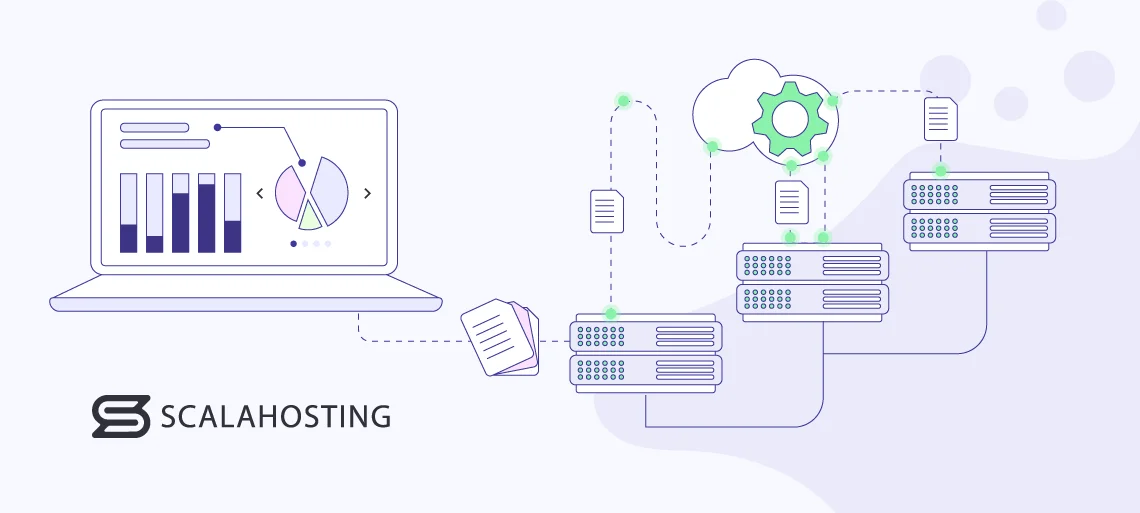
Virtualization technology is also at the core of every cloud computing platform. In basic terms, a cloud is a cluster of physical servers configured to work together and provide a large pool of hardware resources. A cloud can consist of as few as a couple of dedicated servers, but it can also encompass thousands of machines.
A cloud’s computing power can be distributed in a number of ways and used for a variety of services. However, for web professionals, the best option is a cloud-based VPS.
On the surface, cloud VPSs have the same benefits as traditional virtual servers—an isolated hosting environment, guaranteed processing power, storage, and RAM available at all times, and a dedicated IP explicitly reserved for the server owner. However, cloud-based VPS solutions have quite a few other advantages.
Before we get to them, let’s look at the different types of cloud servers.
Difference Between a Managed and an Unmanaged SSD Cloud Server
Anyone who has ever used a shared hosting account knows there’s nothing too complicated about managing it. You usually get a web hosting control panel with a graphic user interface and all the tools you need to control your files, databases, email and FTP accounts, etc.
If you’re switching from a shared solution to a cloud VPS, you may think that running an entire server on your own would be tricky, especially if you have no prior sysadmin experience. Indeed, if you have to do everything yourself, you may struggle to make the most of your virtual server.
That’s why there are managed VPS solutions. With a managed server, your host is responsible for not only deploying the machine but also configuring and maintaining it in perfect working order.
All the technologies required to run a website are preinstalled and configured to extract the best performance from the available server resources. Your provider’s support team will be responsible for tweaking core settings and installing updates and patches as soon as they become available. In other words, specialists with decades of experience will ensure your managed VPS provides a fast, secure hosting environment.
Meanwhile, you get a control panel (just like you do on a shared plan) with a point-and-click interface and the utilities that help you develop and grow your project.
This is good news for most website owners who need a standard setup. However, it might not be ideal for experienced admins with unique web projects and custom configuration requirements.
Hence, there are also unmanaged VPS solutions. With an unmanaged (or self-managed) server, you get the virtual machine with the operating system installed on it, and from then on, your VPS health and performance are in your hands. You can configure all the tools and security systems to your specifications and are free to install any application you want, as long as the operating system supports it.
An unmanaged plan gives you full root access for complete control over the machine. It’s suitable if you want to tweak everything yourself. On the other hand, if you don’t have the time or knowledge to delve deep into the server settings, you’re better off with a managed solution.
10 Reasons to Choose an SSD Cloud Server
Whether you choose a managed or unmanaged plan, a VPS deployed in the cloud gives you plenty of competitive advantages. Let’s look at some of the main ones.
- Speed
Speed is one of the make-or-break factors when it comes to web hosting, and in that respect, cloud servers with SSD/NVMe drives have a definite advantage over traditional HDD servers.
Input/Output Operations Per Second (or IOPS) is a metric that describes the speed at which a device can read or write data. With traditional HDDs, IOPS varies between 80 and 180, but the most modern SSDs can theoretically jump to tens or even hundreds of thousands.
As for the cloud benefits, imagine having the resources of multiple servers instead of a single one—even high-traffic websites can easily run smoothly using this technology.
The performance boost will not only attract more visitors but impress search engines as well. Google considers over 200 factors when ranking websites, with speed being among the most crucial ones.
- Uptime
Because you are utilizing cloud infrastructure, your VPS is supported by a network of servers instead of a single physical machine. This means that even if one of the servers fails, there are other nodes to take up the slack. Infrastructure-related outages are reduced to a minimum, and your site can record high-availability-grade uptime statistics, which helps with both the user experience and the search engine rankings.
- Instant Scalability
One of cloud hosting’s best features is the ability to scale easily. Moving to a more powerful shared plan may require migrating the entire website, especially if the shared server is overcrowded. Upgrades are an even bigger hassle if you’re on a dedicated server.
By contrast, the hardware configuration of a virtual server can be changed on demand, and it usually takes a couple of clicks. The upgrade options are virtually limitless, as well. A cloud can grow infinitely, so you can be sure you’ll have the required resources whenever you need them.
- Advanced Security
Although multiple virtual servers are deployed on the same infrastructure, they all work independently. So, if someone launches a DDoS attack on one of your “neighbors,” for example, your VPS will remain unaffected.
There are more benefits, as well. Cloud technology allows hosts to redeploy their servers with minimum downtime and effort, giving them more leverage to stop ongoing attacks and limit possible damage.
In addition, managed VPS solutions are configured to provide the most secure hosting environment possible, and they often have automated real-time monitoring systems that further boost the server defenses.
- Consistent Performance
The entire VPS is reserved just for you. You don’t need to worry about anyone else hogging up the server and disrupting its performance.
A VPS gives you an isolated environment with hardware resources that are available 24/7, so you know what to expect at any time. This is key to building trust with your site visitors and converting them into return customers.
- Data Redundancy
Cloud VPS servers use software-defined storage – a type of virtualization technology that separates data storage hardware from the software that manages it. Depending on the setup, copies of your server data may even be available and ready to use in multiple data centers.
This means information can easily be replicated and restored even in worst-case scenarios, such as natural disasters, cyberattacks, or regional outages. With the right configuration, the risk of data loss is practically eliminated.
- Better Backup Storage
Cloud storage technology also helps with backup management. Secure copies of your server data can be replicated across the host’s infrastructure, and if the provider uses multiple data centers, backups can even be stored and retrieved from several different locations.
In addition, the flexibility provided by the cloud infrastructure allows hosting providers to implement additional cloud management and recovery techniques, such as file versioning and snapshots.
- Global Accessibility
Big cloud providers like AWS and Google Cloud have points of presence in hundreds of countries across the globe. Your VPS can be easily redeployed in any of your host’s data centers, which reduces latency and improves loading speeds for the people trying to access it.
CDN integration can further boost your performance, and with the correct load balancing and horizontal scaling procedures in place, you’ll never run out of hardware resources.
- Affordability
Several factors make a cloud VPS an excellent financial choice. First, because it’s so easily customizable and scalable, you can tailor your hardware configuration to your specific requirements, so you won’t pay for resources you don’t use.
This lets you save mountains of cash you would otherwise spend on a full-blown dedicated server, and you can thank the cloud for that. In addition to the added flexibility, the virtualization technology powering the cloud lets hosts utilize their hardware more efficiently. That’s how you get a reliable, powerful service at a reasonable price.
- Support
If you choose a managed cloud VPS, your hosting provider will handle the complicated sysadmin tasks. You can forget the worries surrounding data backups, upgrades, maintenance, and virus protection. The idea is to let you focus solely on your business without wasting time and effort dealing with technical issues.
NVMe SSD Cloud Server Hosting
SSDs were initially designed as drop-in replacements for traditional hard drives. You’d remove the old HDD and plug in the new device in exactly the same place on the computer or server motherboard.
The new devices offered better performance, but it soon became apparent that the technology had some untapped potential. NVMe SSD drives were invented to unlock it.
But how do they differ from the standard SSDs?
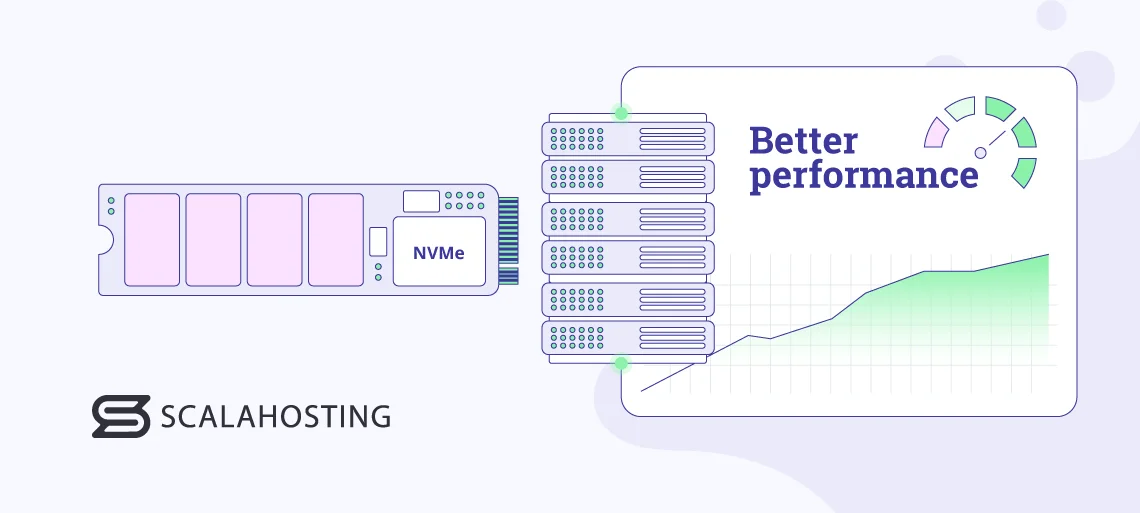
NVMe stands for Non-Volatile Memory Express – a protocol for accessing stored data via the PCI Express (PCIe) interface. There’s no difference in the way the data is recorded. Like standard SSDs, NVMe devices store data in electronic chips instead of writing it on disks.
The difference lies in how the information is relayed between the SSD device and the computer’s CPU. Older SSD drives were designed to work with the old SATA and SAS-3 interfaces. They were much quicker than traditional HDDs, but their speed was hampered by the limited volume of data SATA and SAS-3 sockets can pass.
That’s why the technology was adapted to work with the more modern PCIe bus. With it, the storage device can communicate directly with the system’s CPU.
The performance benefits are remarkable.
Here’s a little illustration:
| Traditional SSD | NVMe SSD | |
|---|---|---|
| Throughput | Up to 12Gbps | Up to 256Gbps |
| Read/write speed | 550MB/s | 3200MB/s |
| IOPS | 10,000 | 640,000 |
| Command depth | 254 entries | 64,000 entries |
As you can see, the speed presented by NVMe drives is far superior to traditional SSDs, and the good news is you can take full advantage of the new technology.
ScalaHosting and SSD Cloud Servers Technology
Cloud VPS hosting is at the core of ScalaHosting’s portfolio of services, so we’ve ensured that our servers offer excellent performance and reliability to website owners of all shapes and sizes.
That’s why we have both managed and self-managed VPS solutions that can be deployed in one of thirteen data centers.
Our managed VPS packages are deployed and configured by our technical experts to provide a hassle-free hosting experience out of the box. All the core server settings and configurations are done by our experienced technicians, and you get to deploy your project through SPanel – an all-in-one server management platform incorporating all the tools you may need to launch and run your website.
If you’re after a custom hosting environment, you can opt for one of our self-managed solutions. With them, you have a choice of operating system. You can pick between four Linux distributions (Rocky Linux, Ubuntu, Debian, and AlmaLinux) and two Windows versions (Windows 2019 and Windows 2022), and you can decide whether or not you want to use a control panel.
All ScalaHosting VPS services run on top of a unique cloud infrastructure built by our experienced sysadmins, and they all work with state-of-the-art NVMe drives.
Final Takes
SSD cloud hosting deserves all the plaudits coming its way — it not only gives you excellent uptime but also offers great speed and unmatched scalability. The cloud infrastructure provides the secure and reliable environment required to grow your business, and an SSD storage device can guarantee the performance people expect from modern websites.
NVMe drives unleash the technology’s full potential, and now, you can take advantage of them, as well.
Check out ScalaHosting’s cloud solutions and empower your business with a first-class web hosting service.

FAQ
Q: Why should I use a cloud server?
A: A virtual cloud server offers several key advantages. Its guaranteed resources provide speed and reliability, while the efficient hardware utilization keeps costs down. The service also comes with unmatched scalability and flexibility, ensuring you’ll never pay for resources you don’t need.
Q: How to choose a cloud VPS server?
A: First, make sure the operating system is suitable for your project, and check whether all the technology you want to use is supported. In terms of hardware resources, covering your project’s minimum requirements should be enough if you’re just getting started, but don’t forget to ensure your host gives you enough upgrade options to help you grow.
Q: Is a cloud server cheaper than a dedicated server?
A: The price of a server depends on many factors, including software licensing fees, the host’s pricing policies, and the management level it provides. However, cloud infrastructure allows for much more efficient utilization of hardware resources as well as comparatively lower data center and maintenance costs. As a result, a cloud server should always be cheaper than a dedicated solution.
What is a VPS – Everything you need to know!