Cheap VPS Hosting: Is It Really Worth The Savings?

Cheap VPS hosting sounds like a great concept in theory, right?
You get all the benefits of a virtual private server (performance, scalability, security) for a few bucks per month – who wouldn’t want that?
But while saving $20-30 from your budget sounds highly appealing, we have to wonder about the hidden catch…or catches. Are you prepared to sacrifice your site performance and uptime, for example? How about dealing with more security loopholes? Or losing your customers’ trust and subsequent sales?
Didn’t think so!
In an era when technology is constantly evolving, people are accustomed to fast websites, secure data, and seamless functionality. To keep them satisfied, site owners need to find ways to make their experience even more flawless, not the other way around.
While cheap options seem economical, they often lead to higher indirect costs, making managed solutions like ScalaHosting’s cloud VPS with SPanel a wiser investment.
But let’s start from the beginning.
What is Cheap VPS Hosting?
Cheap VPS hosting is a low-cost form of Virtual Private Server hosting that offers easy entry into site building for a minimal cost. While VPS services are not that expensive anymore (you can find feature-rich plans for about $20-$30/mo), their low-cost counterparts come at around $10 per month.
Most cheap VPS plans prioritize affordability over performance and convenience. They typically have limited system resources, are unmanaged (or have sub-par support), and include only the basic features and tools to run a website. These plans are commonly offered by budget hosting providers that maximize server utilization to keep prices low, which can often lead to inconsistent performance.
Advantages of Cheap VPS Hosting
- Low entry cost, making it accessible for startups, developers, and small projects;
- Dedicated resources compared to shared hosting;
- Greater control over server configuration and software;
- Basic scalability, allowing upgrades as your project grows;
- Better isolation than shared hosting environments.
Disadvantages of Cheap VPS Hosting
- Limited RAM and CPU, which can restrict performance;
- Unmanaged setup, requiring server administration skills;
- Basic or slow support, often limited to infrastructure issues;
- Performance variability due to high server density or overselling;
- Hidden costs, such as paid backups, control panels, or security tools.
In short, cheap VPS hosting can be a smart stepping stone beyond shared hosting, but the lower price often means more responsibility and potential trade-offs, compared to high-quality virtual servers. The above factors should be carefully weighed before choosing a plan.
The Hidden Costs of Cheap VPS Hosting
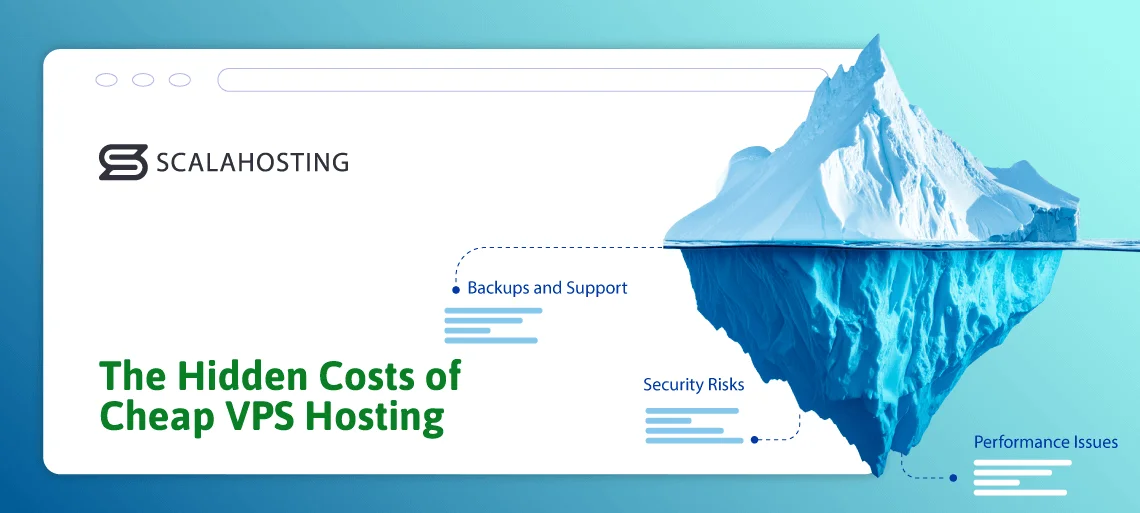
Cheap VPS hosting may look appealing on paper, but the low monthly price often masks hidden costs that can impact performance, security, and long-term business outcomes. Understanding these trade-offs is essential before committing to a budget plan.
Performance Issues
One of the most dangerous risks of cheap VPS hosting is the impact on performance. To keep production costs low, some hosts rent low-tier servers with limited power. This, in turn, means the end client may not receive sufficient power to their website, especially when it starts to grow.
Visitors are especially uncompromising about slow-loading pages and inconsistent responsiveness. Every millisecond can result in losing users and missed potential sales. Those are tangible risks: visitors who leave will likely never return to that page and may lose trust in the brand.
Resource Limitations
Cheap VPS plans often come with strict caps on CPU, RAM, bandwidth, or storage. This is especially evident during traffic spikes: the server cannot accommodate the sudden influx of user requests, resulting in slow-loading pages and even downtime. Imagine releasing a new product on your ecommerce website, running an amazing marketing campaign, but once users start coming in – they cannot really see it, let alone make a purchase.
Cheap servers also affect scalability. If your physical machine is quick to exhaust its resources, you don’t really have a free pool to add more to your project. Cloud hosting is a possible solution, but a robust underlying server is always a plus.
Lack of Backups and Support
The cheapest VPS hosting offers are most often for self-managed servers. This means you get a bare-metal machine, and how you use it is entirely in your hands.
While that might be good for experienced developers who want full control over their hosting service, the feature set and extra tools are practically non-existent. There is no backup solution, no CDN, and no SSL certificates a click away. Most importantly – there is no additional assistance in times of need. Cheap hosting leaves you on your own, without any professional help to back you up.
Security Risks
In tune with the lack of support, you shouldn’t expect much from the security precautions of budgeted hosts. Basic firewall rules, outdated software, limited monitoring/maintenance, and no redundancy plans are among the vulnerabilities that can easily allow an average hacker to access your online assets.
When choosing a new VPS host, you should always ensure they apply multi-level security to their servers and have a well-defined plan for extreme conditions.
| Factor | Cheap VPS Impact | Potential Cost Savings Trade-Off |
|---|---|---|
| Server Resources | Shared/overloaded, slow speeds | $20–$30/month saved, but lost sales from bounces |
| Support Quality | Limited/email-only, slow responses | Hours wasted on DIY fixes |
| Security Features | Basic firewalls, no proactive monitoring | Risk of data breaches |
Impact on Ecommerce Sales
Ecommerce store owners can find cheap VPS hosting especially damaging. Slow load times, particularly on your checkout page, will inevitably damage your revenue and customer trust. As a store owner, you are looking to make your client’s user experience as smooth as possible – perfect presentation of your products, easy-to-use filters, secure personal/payment data, and quick checkout.
Those are only possible if you partner up with a reliable hosting provider. Any other choice can easily lead to:
- Lower conversions and increased bounce rates
Website speed has a measurable impact on buyer behavior. Research consistently shows that each additional second of load time can increase bounce rates by roughly 32%, meaning potential customers leave before they even see your products. Cheap servers often come with resource throttling, which inevitably slows down your potential speeds.
- Ecommerce-specific performance risks
Online stores are quite sensitive to performance and connectivity issues. Imagine shopping around and failing to open specific pages, especially if you already decided to purchase the product. You have to remember that cart abandonment rates rise sharply when users experience lag during checkout. For example, in an ecommerce business generating $20 million annually, a 100-millisecond slowdown could translate into approximately $200,000 in annual revenue loss. The problem with budgeted VPS solutions is that your CPU and I/O performance are highly limited and cannot scale up easily.
- Loss of customer loyalty and brand trust
Your brand reputation is one of your strongest assets – not just for first-time buyers, but for loyal customers as well. Once you lose that – it is almost impossible to regain it. The ecommerce competition is fierce, so you can be sure that if your website is not up to the highest standards – there are plenty of alternatives that are ready to step in.
In contrast with cheap offerings, managed VPS hosting prioritizes consistent performance through optimized configurations, proactive monitoring, and dedicated resources. Faster load times, stable checkout experiences, and rapid issue resolution all contribute to higher conversion rates and stronger customer retention.


Effects of Cheap VPS Hosting on SEO Rankings
Search engine optimization isn’t just about keywords and content — your hosting environment plays a critical role in how search engines rank your site. Cheap VPS hosting can negatively influence SEO performance through speed, uptime, and overall reliability.
Speed and Web Core Vitals
Page speed is a confirmed ranking factor, and Google’s Core Web Vitals focus heavily on loading performance, interactivity, and visual stability. When pages take longer to render, metrics like Largest Contentful Paint (LCP) and Interaction to Next Paint (INP) suffer – increasing the risk of ranking drops.
Search Engine Ranking Loss
Google takes into account over 200 factors when ranking web pages, but page speed is undoubtedly among the most influential ones. Hosting your website on a cheap VPS server hides the risk of increased bounce rates and reduced time on page – two things that send negative engagement signals to the search engine. Even if your actual page content is excellent, there is a high possibility that no one will be able to see it.
Increased Server Latency
Budget hosting providers often offer very few data center locations to place your server, and some don’t even give you an option to choose. This is inconvenient if your main target audience is far from that location, as that increases latency and slows down page delivery.
Downtime and Crawl Reliability
Frequent downtimes are a considerable SEO risk. Search engine crawlers scan your pages at random times, and you want to ensure they are always up and running at optimal speeds. Should the bots detect repeated downtimes, your website will be flagged as unreliable. This introduces a plethora of new problems – reduced crawl frequency, slower content indexation, and even site de-listing.
| Hosting Aspect | SEO Impact | Cheap VPS Risk |
|---|---|---|
| Page Speed | Core ranking factor; slow = lower ranks | Overloaded servers cause delays |
| Uptime | Downtime reduces crawl frequency | Unreliable hardware |
| Security | Hacked sites get penalized | Weak protections |
While cheap VPS hosting may reduce hosting expenses, it can silently erode SEO performance through slow speeds, higher latency, and unreliable uptime. For businesses relying on organic search traffic, investing in stable, well-optimized VPS hosting is a must.
Uptime and Reliability Challenges
Website uptime is the percentage of time your website remains online, often measured on a monthly basis. For most businesses, the industry benchmark is 99.9% uptime or higher, which translates to fewer than 45 minutes of downtime per month.
Downtime has immediate financial consequences. When a website goes offline during a promotion, product launch, or seasonal sale, potential customers simply move on. Should your outages are reocurring – you can expect a surge of unhappy customers, negative online reviews, and an overall loss of trust in your brand.
Another overlooked consequence of unreliable VPS hosting is wasted time. Troubleshooting downtime, opening support tickets, restarting services, or restoring corrupted data diverts attention from core business tasks such as marketing, development, and customer support. For small teams or solo operators, this productivity loss can be significant.
Many low-cost VPS providers rely on high server density and minimal redundancy to keep prices low. While this reduces upfront costs, it increases the likelihood of hardware failures, network congestion, and slow incident response. If you take into account all the losses from potential sales and low search engine rankings, the actual cost of a budget VPS will far exceed even the most premium offers.
The Time Sink: Managing Hosting Problems
When we talk about cheap VPS hosting costs, we often think about the financial aspect of the service. But there are things we cannot measure in dollars, and one of them is highly essential – Time!
Most low-cost VPS plans are unmanaged, meaning the provider gives you a server and little else. Everything beyond basic uptime is your responsibility: system updates, security patches, performance tuning, backups, and troubleshooting when something breaks. While that might not pose a challenge for a seasoned developer, it still takes a good chunk of time to perform on an acceptable level.
At first glance, saving $10–$20 per month for web hosting services feels like a wise decision. In reality, those savings can quickly disappear.
Routine maintenance, unexpected outages, failed updates, or security incidents can easily consume at least 5–10 hours per month. If your time is worth even $20 per hour, that’s $100–$200 in monthly labor costs – far more than what you are saving. And that’s assuming nothing goes seriously wrong, and you need to fix it.
Beyond the raw time investment, there’s the opportunity cost. Hours spent fixing server issues are hours not spent on sales, marketing, product development, or customer engagement. For small businesses, startups, and solo operators, this distraction can slow growth and reduce potential revenue. There’s also a higher risk of human error: misconfigurations, missed updates, or improper security hardening.
All of the above time and opportunity costs are eliminated with a reliable managed VPS plan. Your host’s administrators oversee the server infrastructure and maintenance, while the trained support team assists with monitoring, updates, and technical issues.
Think carefully before you bet on a low-cost VPS – it might turn out you are losing way more money from the lack of associated services.
Why Choose a Better Alternative: Managed Cloud VPS with SPanel
Now that we’ve identified the hidden risks of cheap virtual server hosting, here is our recommendation for anyone who has decided that a managed VPS is the right approach.
Founded back in 2007, ScalaHosting has always aimed to not just break into the hosting market but change it altogether. The company has established itself as a value-driven provider focused on performance, security, and hands-on management from real people. Instead of leaving users to handle complex server tasks alone, ScalaHosting delivers fully managed cloud VPS solutions designed for reliability and growth.
ScalaHosting’s flagship product is SPanel. A multifunctional hosting management platform, this solution is fully in tune with the company’s values and goals. SPanel is lightweight, feature-packed, and its development is closely tied to user feedback.
By betting on this cPanel alternative, you get a clean, user-friendly interface for managing websites, domains, email, WordPress, and MySQL databases. Performance is enhanced through Nginx integration, ensuring fast page loads even during traffic spikes. On the security side, SShield Cybersecurity provides real-time threat detection and blocking, while two-factor authentication (2FA) and continuous monitoring add additional layers of protection.
The benefits extend beyond features. Managed cloud VPS with SPanel includes 24/7 expert support, proactive server management, automatic updates, and high-availability infrastructure – all contributing to consistent uptime and peace of mind. Scalability is built in, allowing resources to grow alongside your business without disruption.
From an ROI perspective, the math is compelling. Paying an extra $20–$30 per month for managed cloud VPS hosting can easily prevent $1,000 or more in lost sales, downtime damage, or recovery costs caused by performance issues or security incidents.
In the long run, managed cloud VPS with SPanel isn’t just a hosting upgrade – it’s an investment in stability, time savings, and sustainable business growth.
Here is a quick comparison with SPanel’s closest competitor – cPanel:
| Feature | Cheap VPS | ScalaHosting Managed VPS |
|---|---|---|
| Management | Self-managed, time-intensive | Fully managed, 24/7 real-human support |
| Performance | Variable speed/uptime | Dedicated resources, Nginx boost |
| Security | Basic | SShield, 2FA |
| Cost Long-Term | Hidden fees from issues | Predictable, value-driven |
Final Takes
Cheap VPS hosting may look attractive at first, but for serious ecommerce and business websites, the risks far outweigh the savings. Performance slowdowns, uptime issues, security gaps, SEO damage, and the hidden cost of your time can quietly erode sales, rankings, and customer trust.
A quality managed VPS solution offers a better path forward. By investing a little more, you gain consistent speed, strong security, expert support, and the freedom to focus on what actually grows your business.
The value of good hosting isn’t just the monthly fee you pay for plan – it’s a complex formula of time, money, and effort. If you want a balanced service that considers all three – a dependable virtual private server is the only way to go!
FAQs
Q: What are the main benefits of cheap VPS hosting?
A: As the name suggests, the biggest selling point of cheap VPS hosting is its price. A lower monthly fee is very lucrative, especially if your business is just starting and you’re on a tight budget. As such plans are often self-managed, another benefit is the complete control – such plans often come with full root access and customization control beyond all else.
Q: Is there a free VPS?
A: Some hosting companies offer free VPS plans. That sounds amazing in theory, but in reality, you will be facing a plethora of unexpected challenges. Such free plans are resource-limited, offer poor performance, and provide subpar security. Downtimes are to be expected, and technical support is practically non-existent. To top it all off, some hosts will place intrusive ads on your website to offset the financial losses from providing a free virtual server.
Q: Do I get a control panel with a cheap VPS?
A: Whether or not you get a control panel with your cheap VPS depends on the type of hosting package. If you opt for a managed virtual server, your hosting management platform is part of the package. In the case of SPanel and ScalaHosting, it comes at no additional cost to the client.
Should you go for a self-managed plan, all you get is a bare-metal server. The control panel and all additional tools have to be purchased separately.
Q: Does a cheap VPS affect SEO?
A: While not directly affecting your search engine optimization, a cheap VPS can easily affect your ranks in a bad way. Such services are often associated with poor performance and frequent downtime, two things that engines like Google severely frown upon. When you also take into consideration the basic security and limited resource supply – your fall down the rankings is rather inevitable.
Q: Are cheap VPS services good for ecommerce stores?
A: Online shops have much to lose if they don’t carefully pick a reliable and secure hosting service. This is why cheap VPS hosting is not a good fit. To keep their prices so low, hosts often save onf features and resources that can directly impact your performance and security. What’s more, cheap plans are often self-managed, meaning you would have to dedicate much more time and effort instead of putting them into growing your ecommerce business.