Scalable Cloud Hosting Without Forced Upgrades

Your site finally takes off. Traffic climbs past 50,000 visitors a month… and suddenly your hosting provider hits you with an ultimatum: upgrade to a $100+ “premium” plan you don’t fully need or stay stuck paying for CPU and RAM you never use.
Sound familiar? You’re not alone.
Recent 2026 hosting surveys show that 72% of growing websites rank forced upgrades and wasted resources among their biggest frustrations.
But scaling doesn’t have to feel like a penalty for success.
Imagine a cloud environment where you can dial CPU cores, RAM, and lightning-fast NVMe storage up or down independently, paying only for what you actually use.
In this guide, you’ll discover how to scale affordably, the technical advantage of true resource customization and clustering, and why a hosting model built from real user votes (our Cloud Democracy philosophy) puts you in control of your infrastructure, not the other way around.
Why Most Cloud Hosting Still Forces Upgrades
Because “cloud hosting” is a popular buzzword in the industry right now, many hosts tend to use it rather loosely. In reality, they just offer the traditional shared model but with a shinier package. This allows them to keep overselling their infrastructure and cram as many customers as possible into a single server.
For those hosts, “scalability” means moving to a higher tier rather than adding more from a single resource.
But this doesn’t really cut it when it comes to steady growth.
Imagine you have a website hosted on a server with 2GB of RAM, 2 CPU cores, and 50GB of disk space. As your website grows, your RAM soon proves insufficient, but you are far from reaching your CPU or storage limits.
Would you feel okay jumping to the next server level, which includes 4GB of RAM, 4 CPU cores, and 80GB of storage?
Didn’t think so.
Industry benchmarks in 2026 show that the average growing website overpays between 35% and 60% due to unused allocated resources.
Тhe benefits for the provider are obvious – infrastructure planning is way easier while the revenue is maximized. But for the client, that means:
- Forced upgrades instead of true scalability
- Wasted budget for resources and tools you don’t really use
- Service disruptions during a server migration
True, granular scaling gives you much more than that.
If you just need an extra CPU core – you can get it without adding other system resources. You pay only for what you utilize. There are no downtimes as you are not switching servers.
Virtualization, containerization, and distributed storage systems already support dynamic resource allocation. So technological advancement isn’t the problem – the pricing and product models are what’s stopping you from achieving the scalability you need.
True Cloud at ScalaHosting: Customize CPU, RAM & Storage – Pay Only for What You Use
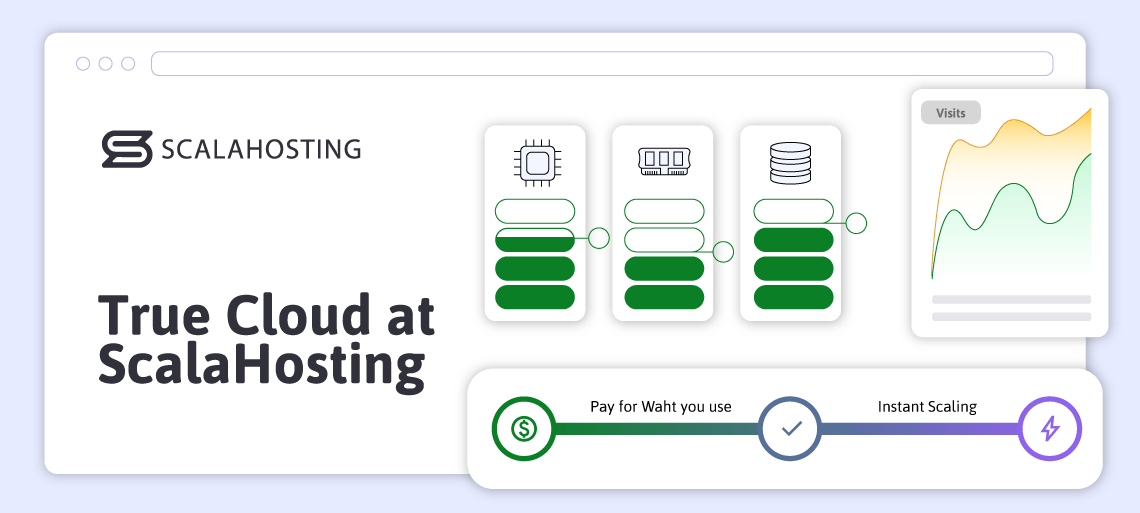
Traditional cloud hosting often promises flexibility, but in practice, it locks customers into rigid packages. Need just a little more RAM? You’re forced to jump to the next expensive tier. Traffic spike for a few days? You pay for the larger plan for the entire month. That’s not real cloud flexibility.
True cloud hosting at ScalaHosting is a different breed.
It’s designed around a simple principle: you should only pay for exactly the resources you use, exactly when you use them. Nothing more, nothing wasted.
Signing up with a Scala Managed VPS Plan, you can either choose a fixed package or build your own server. The latter option allows you to allocate a custom number of CPU cores, RAM, and disk space. As each online project has its own specifics, users need more granular control over resources and pricing.
From there on, it’s all a matter of monitoring. As soon as you are close to reaching a certain limit, adding more from a single resource is just a matter of a few mouse clicks.
This kind of true cloud scalability comes with plenty of benefits:
- One-click upgrades or downgrades
- Instant allocation from the cloud resource pool
- No downtime
- No service interruption
- No manual provisioning delays
- Pro-rated billing
Let’s illustrate this with an example.
- You have an ecommerce store that sells apparel.
- Black Friday is right around the corner, so you decide to boost sales with a worldwide marketing campaign announcing your deals.
- The campaign is a great success, bringing 10x more visitors to your website than your normal daily average.
- Your RAM consumption spikes from 10% to 90%.
- In a traditional setup, this is the point where you have to upgrade your hosting package, move to a new server, and face possible service interruptions.
- That is not the case with ScalaHosting. You simply need to log in to your Client Area and add more RAM from there.
- There is no waiting time, nor are there any data migrations. Your new RAM is added immediately, and your consumption returns to normal.
- After Black Friday, your daily visits drop back, and you can remove the extra RAM as well.
It’s really as simple as that.
Another hidden problem in many cloud environments is performance inconsistency. Smaller plans may run on slower hardware, while premium tiers get better infrastructure.
ScalaHosting’s true cloud eliminates this issue completely.
Every configuration, from the smallest server to the largest, runs on the same enterprise-grade hardware:
- Ultra-fast 4.1 GHz AMD EPYC CPUs
- PCIe 5.0 NVMe SSD storage
The only difference between lower and higher tier plans is simply the amount of resources.
And then comes the price difference.
This is another aspect where true cloud hosting excels. There is really no comparison here. In one case, you pay for an entirely different server with more from every resource. In the other, the extra cost is for a single resource, be it CPU, RAM, or storage.
Let’s look at a price comparison with a 3-year example:
| Provider Type | Base Monthly Cost | Spike Monthly Cost | Flexibility | 3-Year Total |
|---|---|---|---|---|
| True Cloud (custom scaling) | $36 | $36 + $34 (only during spikes) | Instant scaling, pro-rated | $1,476 |
| Typical Cloud Provider (fixed packages) | $72 | Must stay on larger plan | Limited scaling | $2,592 |
| Traditional VPS Provider | $85 | Upgrade required | Manual migration | $3,060 |
Savings with True Cloud:
$1,116 – $1,584 over three years
This also highlights an important distinction between true cloud hosting and its traditional counterpart. While the former focuses on the optimal functionality of the package (product-oriented), the latter revolves around package upgrades (revenue-oriented).
Which would work better for you? We think the answer is obvious!
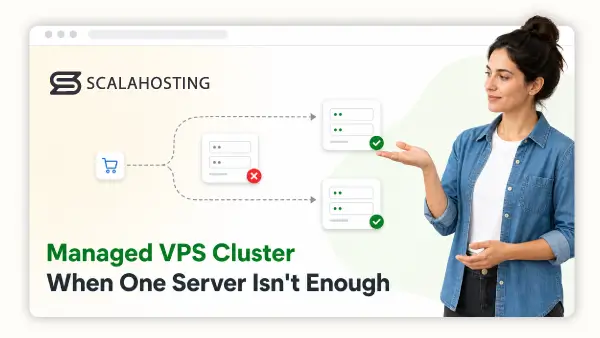
From Single VPS to Full Multi-Server Cluster: Seamless Scaling Path
Every successful online project eventually reaches the same turning point: growth outpaces infrastructure. Traffic increases, workloads multiply, and reliability becomes mission-critical. The real challenge isn’t just scaling – it’s scaling without disruption.
At ScalaHosting, the path from a single server to a fully redundant, enterprise-grade cluster is intentionally designed to be smooth, predictable, and continuous. You don’t switch platforms. You don’t rebuild your environment. You simply grow along a scaling path that was engineered from day one.
- Start Simple: A Single Managed Cloud VPS
When you’re just starting your online project, there is no need to go overboard with web hosting, even if you can afford it.
For startups, SaaS platforms, agencies, and growing businesses, a managed Cloud VPS provides the ideal balance of performance, control, and cost efficiency. It’s powerful enough to handle real workloads, yet flexible enough to scale instantly when demand increases.

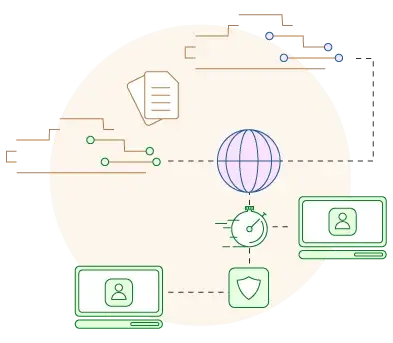
- Reaching a Resource Limit? Just Add More.
The beauty of true cloud hosting is its easy vertical scaling. You stay focused on your product while the infrastructure adapts in real time. At any point, you have access to a practically limitless amount of CPU, RAM, and storage space. The scaling is seamless and involves no service interruptions.
- When Growth Demands More – Move to a Full Cluster
Hosting solutions for high-traffic websites and big enterprises are rarely customizable enough or cost-efficient. The choices are mainly dedicated servers, which are quite costly and even less flexible than traditional cloud offerings.
ScalaHosting has something completely different in mind – cluster hosting!
Instead of a single machine handling everything, workloads are distributed across multiple nodes that work together as a unified system. A true cluster is more than just multiple servers. It’s a coordinated architecture designed to eliminate bottlenecks and remove single points of failure.
Traffic is intelligently distributed across servers using industry-proven technologies:
- HAProxy
- Nginx
- MaxScale
This ensures:
- Even workload distribution
- Automatic failover
- Consistent performance under heavy load
If one node becomes unavailable, traffic is instantly rerouted to healthy nodes.
- Even More Redundancy With Multi-Datacenter and Multi-Region Clusters
Big projects need to be prepared for any contingencies. This includes failures at the data center level (e.g., fires, floods, natural disasters). Cluster hosting prepares you for just that. The Scala offers include:
- Cross-datacenter replication
- Multi-region deployment
- Warm standby environments
- Automatic failover between locations
- Disaster recovery readiness
That level of resilience is typically reserved for enterprise infrastructure, but can be applied to any mission-critical project that cannot afford a single second of downtime. Such plans are well-adjusted to handle big ecommerce projects, websites with 1m+ visitors.
Check out our cluster hosting offers.
- Scaling with Intelligence: Analytics and Usage Alerts
Growth should never catch you off guard.
Cluster environments include advanced monitoring and analytics that track resource usage continuously and alert you before limits are reached.
By default, the system trigger activates at 80% resource consumption, but you can customize that to a value that best fits your project.
This progression from single server to enterprise cluster wasn’t created as a marketing concept. It was engineered in response to real customer demand.
That’s why the scaling path works like a continuum:
Single VPS → Larger VPS → Multi-node cluster → Multi-region infrastructure
Real Benefits & Client Satisfaction Proof
Scalable cloud hosting sounds impressive in theory. But what truly matters is what customers experience in practice – lower costs, predictable performance, uninterrupted reliability, and infrastructure that grows without friction.
This chapter focuses on the tangible outcomes users see every day. This is why we will focus on a few different use cases and see how true scalability can change their development for the better:
Case 1: SaaS Startup with Rapid Growth Phase
Starting point
- Single virtual server
- Early-stage product launch
Challenge
User adoption accelerates faster than expected. Traffic doubles within weeks.
Solution
Incremental resource increase is needed. This includes:
- Additional CPU capacity
- Expanded memory
- Load balancing introduced
Outcome
- No downtime during scaling
- Stable performance under increased demand
- Predictable monthly costs
Within a short period, the infrastructure evolves into a multi-node environment without requiring migration.
Case 2: Ecommerce Platform with Seasonal Traffic Surges
Starting point
- Moderate daily traffic
- Periodic promotional campaigns
Challenge
Traffic spikes during sales events create performance strain.
Solution
Temporary resource scaling during peak periods.
After the campaign ended, resources were reduced to baseline levels.
Outcome
- Fast checkout performance during peak demand
- Lower infrastructure costs outside promotional windows
- No long-term plan changes
The system adapts dynamically to demand cycles, allowing the online store to keep optimal performance during promotional periods and product launches.
Case 3: Digital Agency with Multi-Client Hosting
Starting point
- Hosting multiple websites on a single server
- Juggling clients with different needs and goals
Challenge
Client growth requires improved reliability and redundancy.
Solution
Gradual transition to a clustered environment with load balancing.
Outcome
- Improved uptime consistency
- Simplified management across multiple projects
- Scalable infrastructure supporting new client onboarding
The agency expands capacity without disrupting existing customers. This helps them accommodate new accounts and have sufficient resources to support each user’s eventual growth.
ScalaHosting has already been involved in a huge project, accommodating the presidential elections in the Philippines. This involved hosting a platform with hundreds of thousands of visitors in a short period of time. Check out the video testimonial we received from our happy clients.
How to Scale Your Site in 2026: 9 Actionable Steps
Many users wonder what the best way is to scale their online project to ensure optimal performance and security as visitor numbers grow. While there is no single solution to that answer, there is a logical sequence that most clients can follow:
- Start with a custom VPS build.
- Regularly audit current traffic and resources in SPanel.
- Monitor usage alerts.
- Add CPU/RAM/storage with one click as needed.
- If you continue to grow, request a cluster consultation.
- Choose a Single Data Center, Multi Data Center, or Multi Region solution.
- Test load balancing and failover mechanisms.
- Leverage SPanel tools for caching/staging.
- You can scale down when traffic drops, so that you don’t overpay for resources you’re not using.
The key is following a structured scaling process – one that starts with visibility, adds resources precisely when needed, and evolves into resilient infrastructure only when growth truly requires it.
You start small.
You monitor performance.
You add resources precisely when needed.
You expand architecture only when growth demands it.
And you reduce capacity when demand falls.
That’s what modern scalability looks like.
Conclusion
True scalability isn’t about bigger servers but the freedom to grow without friction.
ScalaHosting delivers real scalable cloud hosting by putting control back in your hands. You customize exactly the resources you need, adjust them instantly as demand changes, and pay only for what you actually use. No rigid packages. No forced upgrades. No unnecessary costs.
Most importantly, your infrastructure evolves along a clear path. You can grow from a single VPS to a fully redundant enterprise cluster without disruptive migrations or platform changes. The same system that supports your first users can support millions more.
That’s what true scalability looks like in practice.
FAQ
Q: What does “true scalability” actually mean in cloud hosting?
A: True scalability means you can increase or decrease resources instantly without changing plans, migrating servers, or paying for capacity you don’t use. You simply add or remove CPU, RAM, or storage as needed — and your billing adjusts automatically.
In practice, it means your infrastructure grows with your business instead of forcing you into larger packages.
Q: Can I really scale my server up without downtime?
A: Yes. Modern cloud infrastructure allows resources to be allocated from a shared pool in real time. When you add CPU, RAM, or storage, the system provisions them instantly without restarting services or interrupting users.
This allows websites and applications to handle traffic spikes smoothly while staying online.
Q: Do I have to upgrade to a bigger plan when my site grows?
A: No. With true scalable cloud hosting, you don’t switch plans – you simply adjust individual resources.
For example:
- Need more memory? Add RAM.
- Need more processing power? Add CPU.
- Need more storage? Expand disk space.
This eliminates the need for costly plan upgrades and prevents overpaying for unused capacity.