A data center location is the physical place where your website’s server runs, and it sets a hard floor on how fast your pages can reach visitors. ScalaHosting offers 24 data center locations across North America, Europe, and Asia-Pacific, built on three types of infrastructure.
Below, we explain what a data center does in web hosting, how distance changes latency and website speed, and what that latency costs you in user experience, conversions, and SEO. Then we map every ScalaHosting data center location by region, compare our Native, Integrated Cloud, and AWS infrastructure, list the standards every facility shares, and walk through how to choose the right location for your audience.
Quick facts (November 2026):
ScalaHosting runs 24 data center locations: 7 in North America, 12 in Europe, and 5 in Asia-Pacific.
Native locations are Dallas, New York, Seattle, and Sofia. Every ScalaHosting service is available there.
Integrated Cloud adds 11 locations in Europe and Asia-Pacific for cloud VPS plans.
AWS adds 13 regions on four continents for Managed AWS plans.
Managed cloud plans carry a 99.99% uptime SLA.
What Is a Data Center in Web Hosting?
A data center in web hosting is a secure facility that houses the servers, storage, and network equipment that keep websites online. A hosting data center supplies those servers with redundant power, cooling, physical security, and high-capacity internet connections around the clock.
When you buy a hosting plan, your site’s files, databases, and email live on a server inside one of these buildings. Every visitor request travels across the internet to that building and back. The facility’s quality decides how reliably your site stays online. Its location decides how far your data has to travel.
The core components of a hosting data center are listed below:
Power: utility feeds backed by batteries and generators.
Cooling: climate control that keeps hardware within safe temperatures.
Connectivity: links to multiple carriers, so traffic always has more than one route.
Physical security: access control, surveillance, and on-site staff.
Monitoring: 24/7 oversight of hardware, power, and network health.
Does Data Center Location Affect Website Speed?
Data center location affects website speed because every request travels from the visitor to the server and back, and longer distances add latency. Light in optical fiber covers about 200 km per millisecond, so every 1,000 km between visitor and server adds roughly 10 ms to each round trip.
That figure comes straight from physics. Light moves about 1.5 times slower in glass fiber than in a vacuum, which works out to about 5 microseconds of delay per kilometer, one way. No upgrade removes it.
Latency is the delay between a request and its response, measured in milliseconds. It isn’t the same as bandwidth. Bandwidth is how much data a connection carries at once. Latency is how long each trip takes, and more bandwidth doesn’t shorten the distance.
Here’s the thing, though.
A browser doesn’t make just one trip. Before the first byte of a page arrives over a new HTTPS connection, the browser opens a TCP connection, completes a TLS handshake, and then sends the request. With TLS 1.3, that’s about three round trips, plus the DNS lookup. Each trip pays the distance cost again.
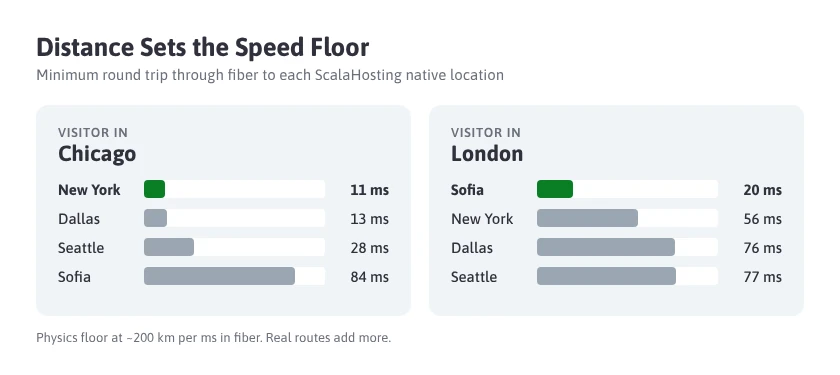
The table below shows the minimum round-trip time through fiber from two visitor cities to each ScalaHosting native location. Real cable routes are longer than a straight line, so measured numbers run higher.
Native location
From Chicago (ms)
From London (ms)
New York
11
56
Dallas
13
76
Seattle
28
77
Sofia
84
20
For a visitor in London, a server in Sofia saves about 57 ms per round trip compared with Seattle. Across three round trips, that’s roughly 170 ms before the page starts loading. Google recommends a Time to First Byte (TTFB) of 0.8 seconds or less, so distance alone can use up more than a fifth of that budget.
The closest native location cuts the latency floor by up to 73 ms per round trip.
How Latency Affects SEO, Conversions, and User Experience
Latency affects SEO, conversions, and user experience by delaying the moment a page starts to render. A slow server response pushes back every step after it, including the main content that visitors wait for and Google measures.
User experience. Every pageview starts with a server response. When that response comes from another continent, visitors wait longer for the first pixel, for every click, and for every form submission. On a store, that delay repeats through product pages, cart, and checkout.
SEO. TTFB isn’t a Core Web Vitals metric, but it comes before Largest Contentful Paint (LCP), which is. A distant server adds latency to TTFB, and that delay carries into LCP. Google also lists server location as one signal about a site’s intended audience, though not a definitive one.
The result? Hosting close to your audience is one of the few speed improvements that needs no code changes at all.
ScalaHosting Data Center Locations by Region
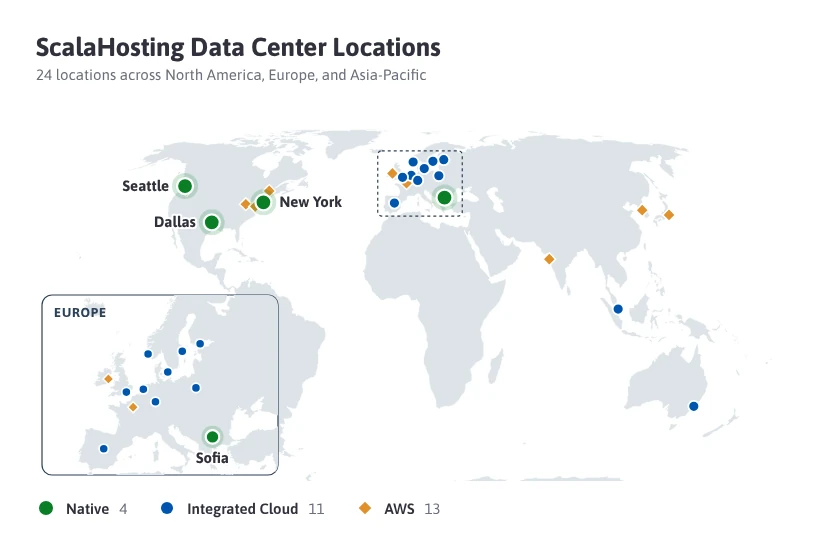
ScalaHosting offers 24 data center locations: 7 in North America, 12 in Europe, and 5 in Asia-Pacific. The four native locations are Dallas, New York, Seattle, and Sofia, while 11 Integrated Cloud locations and 13 AWS regions extend that coverage. You can see the full list on our network and data centers page.
Four cities, London, Frankfurt, Singapore, and Sydney, offer both Integrated Cloud and AWS. That’s why the infrastructure counts add up to more than 24.
North America
ScalaHosting has three native data centers in the US, one on each coast and one in the center. Each covers a different part of the continent:
New York serves the East Coast and Eastern Canada. Toronto is about 550 km away, and New York also has the shortest route to Europe of any US location.
Dallas serves the central and southern US, plus Mexico. Chicago is about 1,300 km away, and Mexico City is about 1,500 km.
Seattle serves the West Coast and Western Canada. Vancouver is under 200 km away, and San Francisco is about 1,100 km.
AWS adds Ohio, Virginia, Oregon, and Montreal for Managed AWS plans.
Europe
Sofia is ScalaHosting’s native European data center and sits inside the EU. Athens, Belgrade, Bucharest, Budapest, Istanbul, and Vienna are all within about 820 km, which keeps the theoretical round trip under 10 ms across most of Central and Southeast Europe.
For Western and Northern Europe, Integrated Cloud covers Amsterdam, Copenhagen, Frankfurt, Helsinki, London, Madrid, Stavanger, Stockholm, and Warsaw. AWS adds Dublin, Paris, London, and Frankfurt.
Asia-Pacific
Integrated Cloud covers Singapore for Southeast Asia and Sydney for Australia and New Zealand. AWS adds Tokyo, Seoul, and Mumbai, along with its own Singapore and Sydney regions.
The table below lists every ScalaHosting data center location by region and infrastructure type.
Region
Native
Integrated Cloud
AWS
North America
Dallas, New York, Seattle
None
Ohio, Virginia, Oregon, Montreal
Europe
Sofia
Amsterdam, Copenhagen, Frankfurt, Helsinki, London, Madrid, Stavanger, Stockholm, Warsaw
Dublin, Frankfurt, London, Paris
Asia-Pacific
None
Singapore, Sydney
Mumbai, Seoul, Singapore, Sydney, Tokyo
Native locations in green, Integrated Cloud in blue, and AWS regions in orange.
Native, Integrated Cloud, and AWS Infrastructure Explained
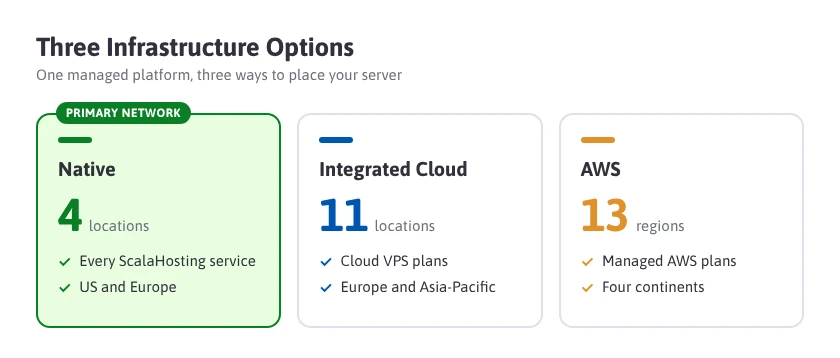
ScalaHosting’s three infrastructure types differ in where they run and which plans they support. Native infrastructure supports every ScalaHosting service, Integrated Cloud brings cloud VPS plans to more cities at slightly higher prices, and AWS supports our Managed AWS plans.
ScalaHosting Native Infrastructure
ScalaHosting native infrastructure is our primary network, available in Dallas, New York, Seattle, and Sofia. Every ScalaHosting service runs on native infrastructure, from managed cloud hosting to cluster setups, at our standard pricing. If most of your visitors are in North America or Southeast and Central Europe, start here.
Integrated Cloud Infrastructure
Integrated Cloud extends ScalaHosting’s cloud VPS plans to 11 more cities in Europe and Asia-Pacific. Pricing runs slightly higher than in native locations, and in return you get a server much closer to audiences that native locations don’t reach as well, such as visitors in the Nordics, Spain, Southeast Asia, or Australia.
AWS Infrastructure
AWS infrastructure is an extra option for businesses that want their server on Amazon Web Services. It’s available only with our Managed AWS hosting plans, across 13 regions on four continents. We provision and manage the server for you, so you don’t need your own AWS account.
The table below compares the three infrastructure options.
Infrastructure
Locations
Available plans
Pricing
Typical fit
Native
4
Every ScalaHosting service
Standard
Audiences in North America and Southeast or Central Europe
Integrated Cloud
11
Cloud VPS plans
Slightly higher than native
Audiences in Western or Northern Europe and Asia-Pacific
AWS
13
Managed AWS plans only
Managed AWS plan pricing
Businesses that require AWS infrastructure
Native is the primary network. Integrated Cloud and AWS extend its reach.
What Every ScalaHosting Data Center Has in Common
Every ScalaHosting data center location runs in a facility with redundant power and cooling, multi-layer physical security, 24/7 monitoring, and a 10 Gbps redundant network. Location changes your latency, not the standard of the building your server sits in.
The standards our data centers share are listed below:
Redundant infrastructure: power, cooling, and backup generators are duplicated, so a single component failure doesn’t take your server offline.
Redundant network: a 10 Gbps network with multiple uplinks keeps latency low and provides a backup path for traffic.
Physical security: biometric scans, video surveillance, photo ID checks, and mantraps protect each facility, with multi-factor authentication for restricted areas.
24/7 monitoring: a dedicated operations team works with on-site staff around the clock.
Renewable energy: we choose partners that use renewable energy sources to limit their environmental impact.
Certified facilities: our data center partners follow standards including ISO 27001, SOC 1 Type II, SOC 2 Type II, and PCI DSS.
These certifications belong to our partners’ facilities. They support your own compliance work, for example a PCI DSS assessment for an online store, but they don’t make a website compliant on their own. In addition to facility standards, managed cloud plans include a 99.99% uptime SLA.
How to Choose the Right Data Center Location
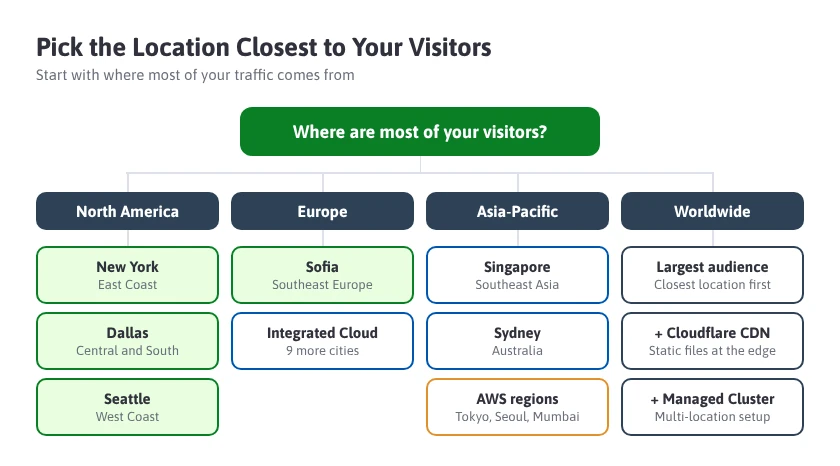
Choose the data center location closest to the largest share of your visitors. Check where your traffic comes from, pick the nearest ScalaHosting location, and then adjust for data rules, global reach, and how much downtime your business can afford.
Follow these steps to choose your location:
Find where your visitors are. Open your analytics and check traffic by country and city. If revenue comes from a different region than raw traffic, weigh revenue more heavily.
Start with a native location. If most of your audience is in North America or Southeast and Central Europe, Dallas, New York, Seattle, or Sofia gives you every service at standard pricing.
Use Integrated Cloud to close the gap. If your audience sits far from a native location, such as in the Nordics, Spain, Southeast Asia, or Australia, an Integrated Cloud city shortens the trip.
Add a CDN for global reach.SPanel activates the Cloudflare CDN from the control panel, which caches images, scripts, and stylesheets near your visitors. Dynamic pages, checkout, and logged-in sessions still come from your server, so its location still matters.
Plan for a second location if downtime is costly.Managed Cluster Hosting can run a primary cluster in one data center and a standby in another, so your site survives a full facility outage. Every cluster is designed around your workload.
Not sure which location fits your project? Talk to our team, and we’ll recommend a location based on where your visitors are and what you’re running.
Start from your largest audience, then add a CDN or a second location for global reach.
Host Close to Your Audience
Distance is the one part of website speed that no plugin can fix after the fact. Pick the ScalaHosting data center location closest to most of your visitors, and every page, click, and checkout starts faster.
Explore ScalaHosting’s managed cloud hosting plans and choose your location at checkout.
Supercharge Your Business with an All-inclusive Fully Managed Cloud
A: Yes. A CDN caches static files near visitors, but every uncached request, such as the HTML page, search results, a cart, or a checkout, still travels to your server. A data center close to your audience keeps those requests fast.
Q:Does data center location affect SEO?
A: Yes. Data center location affects SEO indirectly through page speed. A distant server raises Time to First Byte (TTFB), which delays Largest Contentful Paint (LCP), a Core Web Vitals metric. Server location is also one signal Google uses about a site’s intended audience.
Q:Which ScalaHosting location should I choose for a European audience?
A: Sofia is the native location for audiences in Southeast and Central Europe, with every ScalaHosting service available. For Western and Northern Europe, Integrated Cloud locations such as Amsterdam, Frankfurt, London, and Stockholm sit closer to your visitors.
Q:Can I host my website in more than one data center?
A: Yes. Managed Cluster Hosting supports multi-data center setups, with a primary cluster in one location and a standby cluster in another. Our technical team designs each setup around your traffic, database load, and redundancy needs.