Best Cloud Hosting for Small Businesses

As a small business owner, juggling limited budgets while trying to scale your online presence can feel like walking a tightrope… that is, until cloud hosting steps in.
In 2026, traditional servers are increasingly rigid, costly, and ill-suited to rapidly evolving digital demands. Cloud hosting, by contrast, offers the flexibility to scale resources on demand, lower upfront costs, and enterprise-grade reliability, often delivering 99.99% uptime. This is a critical advantage as e-commerce and online services continue to surge. According to recent Gartner reports, 85% of small businesses say cloud solutions have improved their ROI.
Cloud hosting today is no longer optional, but essential.
In this guide, we’ll rank the best cloud hosting options for small businesses, with a closer look at why ScalaHosting’s managed cloud VPS stands out as the #1 choice when it comes to affordability, performance, and long-term growth.
What Makes Cloud Hosting Ideal for Small Businesses?
Looking around for a suitable hosting plan, you will most likely come across options like shared services, VPS solutions, and dedicated servers. They all come with certain pros and cons:
- Shared hosting is the most affordable web hosting type, often preferred for small test and personal websites. It’s cheap and easy to use, but because server resources are utilized by hundreds, even thousands, of clients, you cannot really count on good performance and security.
- VPS servers are a good middle ground for growing websites. You get an isolated virtual account with dedicated resources, allowing you to achieve better speeds and customization control. But as your account is still tied to a single physical server, scalability is still limited, and the learning curve is a bit steeper.
- Dedicated servers, as the name suggests, are used by a single client and offer full root access for heavier customizations. The price of the service is a big turn-off, though, often coming to hundreds of dollars each month – quite unaffordable for startups and small businesses.
So, what can you do if you are looking to get the best out of both worlds – a scalable plan with enough resources to make a growing website fly?
The answer is cloud hosting!
Cloud hosting works differently. Instead of relying on one physical server, your website runs on a network of interconnected servers. Resources such as CPU, RAM, and storage are elastic, meaning they can scale up or down based on real-time demand. Combined with a pay-as-you-grow pricing model, this allows small businesses to start lean and expand only when needed – without paying for unused capacity.
Cloud Hosting Benefits for Small Businesses
Small business owners already have a lot on their plates. They have to establish their brand, develop great products, build a fast and secure website, and spread the word about it, all with a rather limited budget. This is why their ideal partner is a hosting service that will solve their technical requirements, while the owner focuses on business development.
Cloud hosting ticks all those boxes:
- Cost-efficiency
Оne of cloud hosting’s biggest advantages. There’s no need for upfront hardware investments, maintenance contracts, or overprovisioning “just in case.” Businesses only pay for the resources they actually use, freeing up cash flow for marketing, staffing, or product development.
- Scalability
Traffic spikes from seasonal sales, promotions, or viral content can overwhelm shared hosting plans, leading to poor performance and downtime. Cloud hosting absorbs these spikes seamlessly, ensuring consistent performance during high-demand periods. Instead of worrying if you’re about to hit your hosting plan limits, you can add more CPU and RAM on the go.
- Enhanced security
Another major benefit of cloud hosting for small businesses is the peace of mind it provides. Cloud environments isolate resources, reducing the “bad neighbor” problems, so common in shared hosting. Many providers also include automated backups, proactive threat detection, and redundancy across multiple servers, improving resilience against both cyberattacks and hardware failures. This hosting type is much more resilient to DDoS attacks as well, as there is no single point of failure to target with spammy traffic.
- Ease of management
Cloud hosting is accessible even to non-technical users. Managed cloud plans will pair you with a team of experts who will handle updates, monitoring, and optimization behind the scenes. This allows small business owners to focus on running their operations rather than managing servers and solving technical issues.
Key Criteria for Choosing the Best Cloud Hosting Provider
There are literally thousands of hosting providers on the market, many of which offer some kind of cloud services. The companies vary in reputation, infrastructure, data center locations, feature sets, and prices.
So how can we choose the best one?
For starters, you have to know there is no single offer that is “best” for any type of client and project. Depending on your requirements, you might find one or the other more fitting. That being said, there are some essential factors to consider that will aid you in making the most reasonable decision:
- Affordability
While no choice for hosting service should be entirely price-driven, cost is always a driving factor for small businesses. Avoid platforms that rely on hidden fees for essentials like backups, security, or control panel access. The key here is transparency – you want to be able to predict your overall expenses, so you can plan your long-term growth. Don’t just look for cheap VPS hosting – look for one that will be able to satisfy your needs at a cost-effective price.
- Performance and Scalability
Cloud hosting should deliver optimal speeds and flexibility to grow from the get-go. Not tomorrow and not a month from now. Look for providers that offer NVMe storage, much faster than SSD solutions and the archaic HDD offers. Equally important is the ability to upgrade CPU and RAM without downtime, allowing your site to scale smoothly during traffic spikes or expansion phases. Your website is the face of your small business, and you want to ensure the best possible environment for it to thrive.
- Security and Compliance
Cybersecurity is non-negotiable, especially for ecommerce and data-driven businesses. The best providers include built-in firewalls, proactive threat monitoring, free SSL certificates, and compliance with standards like PCI-DSS. These features protect customer data while reducing the need for costly third-party tools.
- Support
Most cloud hosting companies can offer you 24/7 support, but very few are actually putting effort into efficiently helping customers through multiple support channels. Real human assistance is vital, especially in cases that cannot be addressed by a simple tutorial or chatbot question. Make sure to test the support team of your chosen host before committing.
- Ease of use
Cloud hosting doesn’t have to be a challenging task to manage for small business owners. Powerful platforms can be accessible, and this is fully possible through intuitive control panels, easy server administration, one-click app installers, and free data migrations. Your main focus should be your business, while your provider takes care of the hosting technicalities.
- Uptime and Global Reach
Reliable cloud hosting should come with at least 99.99% uptime, SLA backed by redundant infrastructure. Providers with multiple global data centers and great connectivity deliver faster load times to international audiences and greater resilience against outages.
- Upgrade Path
Your business might just be blooming, but you have to think a few steps ahead. Ensure your chosen cloud provider allows you to seamlessly add more resources or easily upgrade you when you hit the limits. The good thing about a cloud VPS is that you have access to a practically limitless pool of resources, avoiding the time and hassle associated with server migrations.
Top 3 Best Cloud Hosting Providers for Small Businesses in 2026
Cloud hosting continues to dominate the market in 2026, thanks to its scalable infrastructure, speed-driven solutions, and rock-solid security.
But which providers stand out as most deserving for the clients’ vote of confidence?
After careful research, we have singled out three hosting companies that combine most of the essential factors that help startups and small businesses thrive with the fewest obstacles.
Here they are:
#1 ScalaHosting – Managed Cloud VPS (Best Overall)
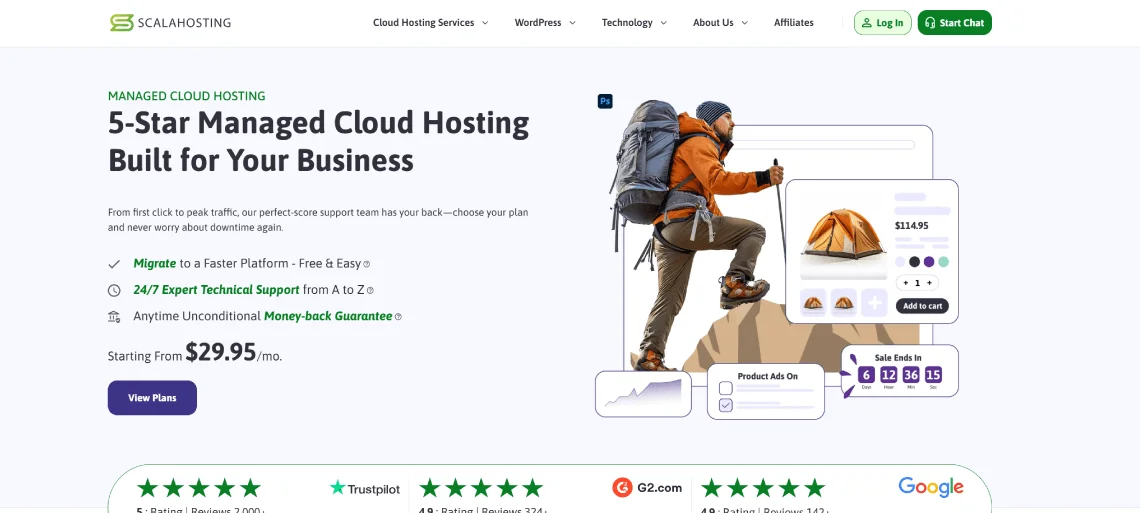
ScalaHosting earns the top spot by delivering true cloud VPS performance at a price point traditionally associated with shared hosting. The company heavily relies on unique tools and developments that are entirely client-driven.
Why ScalaHosting Leads in 2026
ScalaHosting’s entry-level Managed Cloud VPS starts at $14.95/month, yet includes dedicated resources:
- 2 CPU cores
- 2GB RAM
- 50GB NVMe SSD storage
This eliminates the “noisy neighbor” problem common with shared hosting, while remaining affordable for startups and small businesses.
Key Features
- SPanel (Free forever): A modern, lightweight alternative to cPanel that includes backups, email, security, and app management. You can save hundreds per year in licenses alone.
- SShield Security: AI-driven protection with a 99.998% attack block rate, proactively stopping threats before they hit your site.
- OpenLiteSpeed: Delivers up to 3× faster load times compared to traditional web servers.
- Daily automated backups (included, not upsold).
- Free site migrations handled by experts.
- 24/7 managed real-human support, even at entry-level plans.
Pros
- Affordable entry pricing
- Fully managed experience
- Exceptional performance and security
- Clear, future-proof upgrade path
Cons
- Optional root access may have a slight learning curve for beginners
Scalability Spotlight
ScalaHosting excels where many providers stumble: growth. With one-click upgrades, users can scale seamlessly. No downtime, no migrations, grow all the way to enterprise-grade configurations without a hitch.
- Up to 240 CPU cores
- 1024GB+ RAM
- 100TB+ NVMe storage
You simply add resources as needed while your site keeps running uninterrupted. That is the true power of the cloud.
Real-World Case Study
What better way to test your service capabilities than hosting an entire nation? That is exactly what ScalaHosting did in 2022, when the company faced the seemingly impossible challenge of serving the Philippine Presidential Elections. Scala designed a custom multi-data center architecture to ensure 100% uptime even if a single server or an entire data center goes down. The stakes were higher than ever, but the results were more than excellent – the configuration proved to be unbreakable.
#2 Cloudways – Flexible Multi-Cloud Platform
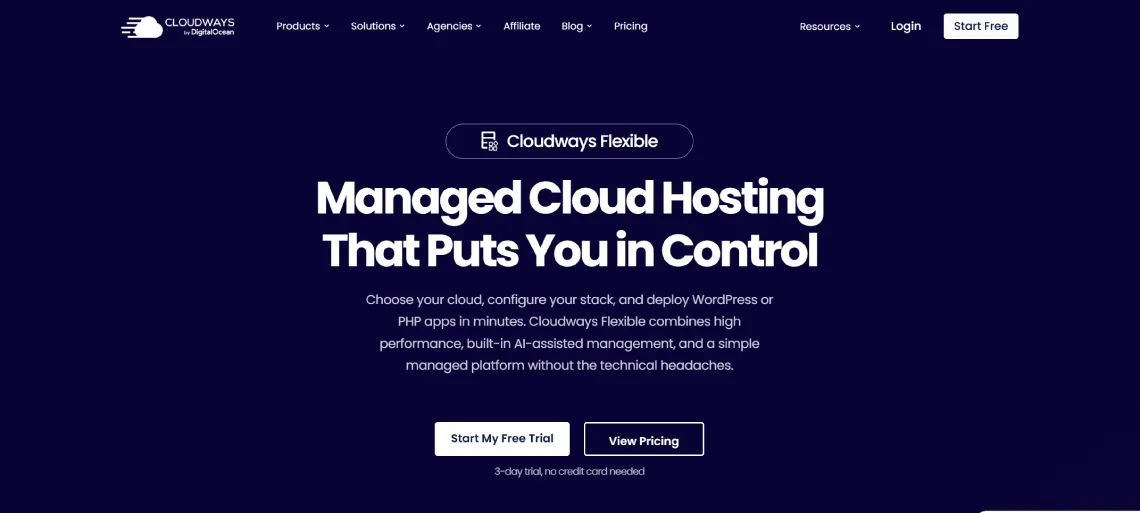
Cloudways is a strong option for developers and agencies who want to deploy across major cloud infrastructures like AWS, Google Cloud, and DigitalOcean from a single dashboard.
Key Features
- 50+ global data centers for ultimate connectivity
- Built-in caching and CDN for enhanced performance
- Free AI Copilot credits
- Free Object Cache Pro
- Built-in firewall with IP blocking
- Free WordPress Vulnerability Scanner for better WP security
Pros
- Multi-cloud flexibility
- Pay-as-you-go infrastructure
- Solid performance on premium cloud providers
Cons
- Higher starting prices than ScalaHosting
- Less beginner-friendly support
- Missing built-in email account management, requiring third-party services
- Only a 3-day free trial
Pricing: Plans start at a seemingly low price ($14/mo) but for a very basic server – 1 CPU, 1GB RAM, and 25GB disk space. From there, things start to get a little pricey, with a standard 2CPU, 4GB RAM server coming to a whopping $54/mo.
Verdict: Powerful, but better suited for technical users with larger budgets.
#3 SiteGround – Performance-Focused, Premium Pricing
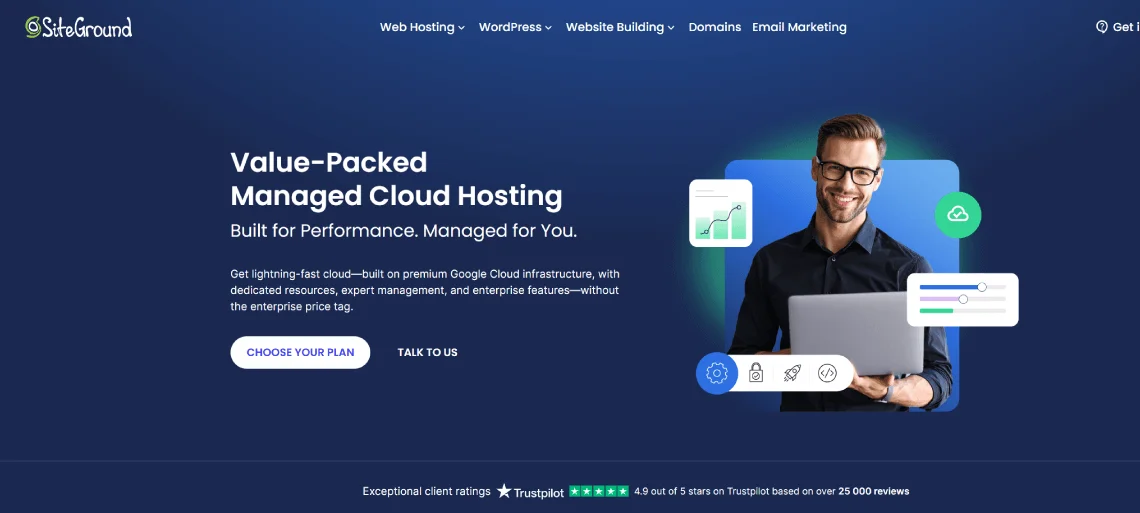
SiteGround leverages the Google Cloud infrastructure, delivering fast load times and strong reliability. The company is recognized as an excellent WordPress provider, offering more than a few benefits for WP users.
Key Features
- Automated resource scaling
- Free SSL and CDN
- Dynamic caching for non-static resources
- WordPress automatic installation and updates
- WordPress Migrator plugin
- Developer tools like WP-CLI and SSH
Pros
- Excellent speed and caching
- Reliable Google Cloud backend
- User-friendly interface
Cons
- Limited server customization
- Expensive upgrades
- More restrictive support at higher tiers
Pricing: Entry plans are competitive, but scaling quickly becomes costly. The cheapest SiteGround Cloud plans start from $100/mo, though even the Jump Start package comes with 4 CPU cores and 8GB RAM.
Verdict: Great performance, but less flexible and more expensive for growing businesses.
| Provider | Starting Price | CPU/RAM/Storage (Entry) | Upgrade Max | Key Strength | Uptime SLA |
|---|---|---|---|---|---|
| ScalaHosting | $29.95/mo | 2 cores / 4GB / 50GB NVMe | 240+ cores / 1024GB+ / 100TB+ | Managed scalability | 99.99% |
| Cloudways | $54/mo | 2 cores / 4GB / 80GB | Varies | Multi-cloud | 99.99% |
| SiteGround | $100/mo | 4 cores / 8GB / 40GB | 33 cores / 130GB / 1TB | Google cloud | 99.98% |
Why ScalaHosting’s Entry-Level Cloud VPS Is a Game-Changer for Small Businesses
For many small businesses, moving past shared hosting is an important step, but one they have to inevitably make in their growth process. Improving performance, security, and scalability is a no-brainer for any commercial project, one that needs careful consideration.
ScalaHosting’s entry-level Managed Cloud VPS hits this sweet spot perfectly – delivering VPS power without the typical headaches and prohibitive costs associated with unmanaged cloud plans.
Affordability That Doesn’t Compromise Performance
At first glance, the Entry Cloud plan sounds like a buffed shared service, priced at only $14.95/mo. But there is so much more than the price tag.
Rather than battling slowdowns or resource throttling under shared hosting, small business sites benefit from dedicated CPU and RAM that deliver consistent performance even under moderate load. This means faster page loads and fewer service disruptions without overpaying for enterprise-level infrastructure.
With Scala’s Entry Cloud, you get all the sweet benefits of a cloud plan – free SSL certificates, a CDN, developer tools, real-time malware protection, and even an AI-powered WordPress SiteBuilder. The package is equipped with all of ScalaHosting’s unique tools – you have SPanel (control panel), SShield (security monitoring), WordPress/Joomla Manager, the works.
High-End Features That Matter
ScalaHosting doesn’t just give you a bare-metal server that is yet to turn into a powerful hosting machine. You have it all from the get-go – the prime infrastructure, the associated software, and the add-on tools to go the extra mile.
Small businesses must stay competitive at all times, and technical obstacles are out of the question. This is why our cloud hosting for startups comes fully equipped with:
- HTTP/3 support ensures quicker, more reliable connections for modern browsers.
- 10Gbps network backbones accelerate data transfer across the globe.
- Multiple global locations (US, Europe, Asia) reduce latency by serving content closer to your audience.
Having this as a foundation, you are surely in the race, even against more established companies and enterprises.
Grow at Your Own Pace
SMBs don’t always grow in a straight line, but ScalaHosting’s Entry Cloud VPS does. You can start small and scale effortlessly as you grow:
- Add CPU cores during high-traffic seasons.
- Increase RAM for database-intensive applications.
- Benefit from one-click upgrades right from your SPanel.
This is a huge plus for small businesses looking for the best cloud hosting to accommodate their project. You can always be sure you are in control of your cost, don’t overspend for resources you’re not using, and keep your budget within reasonable limits.
What Users Are Saying About ScalaHosting’s Entry Cloud
- ScalaHosting makes me feel like a truly valued customer. They not only provide free SSL certificates and server-side assistance to ensure everything runs smoothly, but they also go the extra mile to make sure their clients succeed. Their Cloud VPS hosting has been rock solid, and their self-developed SPanel is easy to use and included for free – Trustpilot Customer
- Thanks to their support line that helps me with all my issues 24/7. They solved many of my issues with my Cloudflare settings.
This is the first time I have written about a hosting service after 25 years of web publishing. The reason for this is that I feel safe and secure at a reasonable price. This is the first time I feel like a special customer.
I recommend the Entry Cloud package with a dedicated IP. It is more than enough for my sites with 100k daily traffic. The best package in terms of price/service ratio. – Trustpilot Customer
Potential Cloud Hosting Drawbacks and How to Overcome Them
Objection: Cloud hosting is too difficult for a novice user.
Solution: While managing an entire virtual server might seem overly complicated, many providers offer managed cloud services. Choosing such a plan, you have your host’s support team deal with all technicalities. You have the experts configuring your hardware, installing essential software, implementing security measures, and resolving technical issues. The client is entirely focused on the Business side of things.
Objection: Cloud hosting is much more expensive than shared hosting.
Solution: While shared solutions are generally cheaper, cloud hosting prices are not too far off. And when it comes to cost-effectiveness, there is a huge gap between the two service types. Cloud plans are much more performance and security-optimized, you can scale up steadily, and the customization freedom is unmatched. Overall, for just a few dollars more, you are guaranteeing a much more stable foundation for any type of business.
Objection: I am selling just a few products – why do I need cloud hosting?
Solution: Ecommerce shops have a lot to gain from cloud hosting. The service offers you transparent pricing with enough resources to handle traffic spikes. You might be launching a new, exciting product or running a lucrative marketing campaign – your website will always be ready for new visitors without compromising on their performance or security.
Objection: I am afraid of going into a long contract with a provider I might not like.
Solution: Reducing risk is a key part of any business venture. Hosts that value customers always try to offer a fair Free Trial or Money-back Guarantee to give potential clients peace of mind. At ScalaHosting, our money-back guarantee lets you cancel at any time and receive a refund for any unused time.
Conclusion and Next Steps
For small businesses searching for the best balance of cost, performance, and scalability, ScalaHosting clearly leads the pack. Throughout this guide, we’ve seen how modern cloud hosting solves the core challenges small businesses face – unpredictable traffic, tight budgets, security risks, and the need to grow without disruption. ScalaHosting stands out by combining dedicated cloud VPS resources, strong security, intuitive management with SPanel, and a seamless upgrade path, all at a price that remains accessible as your business scales.
If you’re still relying on shared hosting or struggling with an inflexible setup, now is the ideal time to move forward.


FAQs
Q: Is cloud hosting affordable for small businesses?
A: Yes. Many providers now offer entry-level cloud plans under $30/month, making cloud hosting cost-effective compared to the long-term limitations and hidden costs of shared hosting.
Q: Do small businesses really need cloud hosting?
A: If your site handles customer data, online payments, or growing traffic, cloud hosting is strongly recommended. It reduces downtime risk, improves speed, and scales easily when your business needs it.
Q: Is managed cloud hosting better than unmanaged?
A: For most small businesses, managed hosting is indeed the better choice. Such services are packed with features and extra tools for building and managing a website. What’s more, you are free of any technical headaches as you have your host’s support to handle this part of your venture.
Q: Can I upgrade cloud resources as my business grows?
A: Absolutely. One of cloud hosting’s biggest advantages is seamless scaling, letting you add CPU, RAM, or storage without downtime or migrations.
Q: What features should small businesses prioritize in cloud hosting?
A: The needed features vary between project scope, but you generally want to secure a server with enough CPU, RAM, and disk space to accommodate a growing audience. Data backups are a must as well, something every business can benefit from. Security add-ons, such as SSL certificates, CDN, dedicated IP, and real-time malware protection, are a good addition, especially if you’re running an ecommerce business.